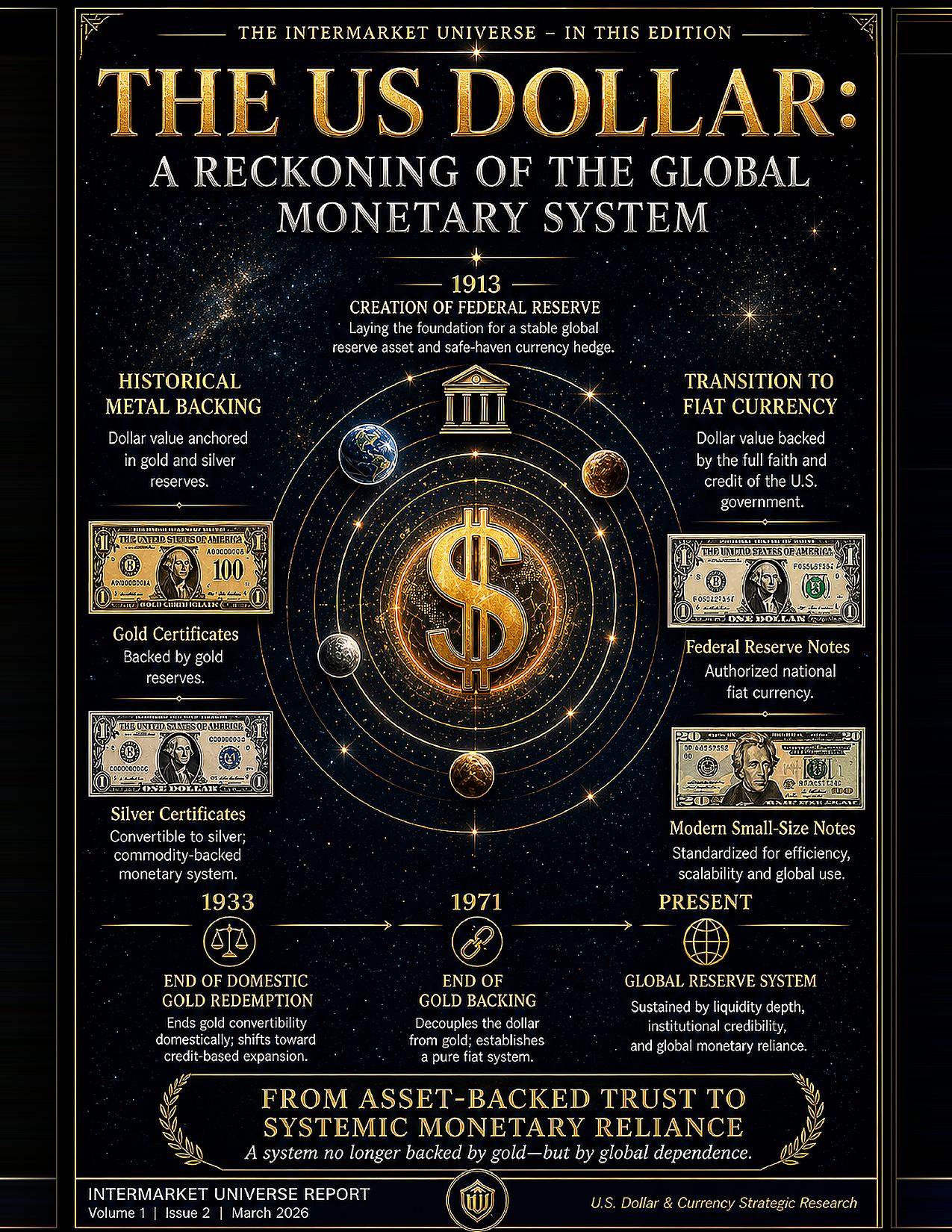
Macro · Currency · Strategy

U.S. Dollar & Currency Strategic Research: The Dollar in a Multi-Polar World

March 2026 · Volume 1 · Issue 2 · 30 min read · Intermarket Universe
+65%
Gold Return in 2025
↑ Dollar Decline Era
+144%
Silver Return in 2025
↑ Hard Assets Surge
50-yr Low
Dollar H1 2025
↓ Worst Performance
4.40%+
10-Yr Treasury Yield
War Premium 2026

Volume 1 | Issue 2 | March 2026

IN THIS ISSUE

I. The Nixon Shock and the Birth of the Fiat Dollar (1971-1979)

II. The Volcker Reset: How 20% Rates Built the Dollar's Modern Throne (1980-1999)

III. The 21st-Century Cycle: Crisis, QE, and the Weaponization of Reserves

IV. The 2025 Crack: Tariffs, the Sell America Trade, and the Worst Dollar Drop in 50 Years

V. Operation Epic Fury: War, Oil, and the Stagflation Trade (2026)

VI. Asset Allocation Scorecard: The Dollar vs. Gold, Silver, Bitcoin, and the Swiss Franc

VII. The Dollar Smirk: Portfolio Strategy for a Multi-Polar Monetary Order

EXECUTIVE SUMMARY For five decades, the U.S. dollar has been the default allocation for investors seeking shelter from geopolitical chaos. That trade is breaking down. Gold returned +65% in 2025. Silver delivered +144%. The Swiss Franc gained 13% against the greenback. Meanwhile, the dollar posted its worst first-half performance in 50 years, and U.S. Treasuries—once the world's risk-free asset—are now demanding a war premium as 10-year yields push past 4.40% in the wake of Operation Epic Fury.

This report traces the dollar's evolution as a portfolio hedge from the moment Nixon severed the gold link in 1971 through the stagflationary reality of March 2026. Each era is evaluated not as history, but as an allocation decision: what did the dollar do for your returns, and what did you leave on the table? The conclusion is uncomfortable but clear—the era of the dollar as a singular safe haven is over. The winning portfolios of the next decade will be built on a diversified base of hard assets, selective currency exposure, and a willingness to hedge the hegemon itself.

I. THE NIXON SHOCK AND THE BIRTH OF THE FIAT DOLLAR (1971-1979)

Before August 15, 1971, the dollar's role as a hedge required no market thesis—it was an institutional fact. The Bretton Woods Agreement had pegged the greenback to gold at $35 per ounce, and every other major currency was pegged to the dollar. It was the numeraire for global trade, enforced by treaty and underwritten by U.S. gold reserves. But by the late 1960s, foreign official dollar holdings had swollen to approximately $36–40 billion while U.S. gold reserves held barely $10.2 billion. The system was untenable, and Nixon pulled the plug.

What followed was something no living investor had experienced: a major reserve currency unmoored from any physical anchor. The DXY—formally created in March 1973 with a base of 100.00 against a basket of ten major currencies—immediately began to slide. The 1973 OPEC oil embargo turned the slide into a rout. Since oil was priced in dollars, the falling greenback effectively cut OPEC revenues, prompting the cartel to weaponize supply. Inflation, which had run near 1% in the mid-1960s, hit 6.2% for full-year 1973 and peaked near 11% in 1974. Fed Chairman Arthur Burns eventually pushed the funds rate to 13% by mid-1974, but it was too little, too late.

The Petrodollar Save The structural rescue came not from monetary policy but from geopolitics. By 1974, the U.S. had brokered an agreement with Saudi Arabia: oil would be priced exclusively in dollars, and Saudi surpluses would be recycled into U.S. Treasuries, in exchange for American military protection. This petrodollar system created a self-reinforcing loop

Volume 1 | Issue 2 | March 2026

of global dollar demand that effectively replaced gold as the dollar's backing. It remains the hidden pillar of dollar hegemony to this day—despite periodic claims of its expiration, no formal treaty with an end date exists, and the vast majority of Saudi oil sales remain dollar-denominated.

For allocators, the 1970s were a brutal lesson. The DXY fell from an estimated 111 in 1971 to 85.82 by 1979. Gold, freed from its $35 peg, surged from $35 to $512 by year-end 1979—a 1,363% return that dwarfed everything else in a diversified portfolio. Real returns on U.S. Treasuries were deeply negative for most of the decade. The Swiss Franc and Deutsche Mark emerged as superior stores of value. The message was stark: in a stagflationary environment, the dollar is not a hedge—it is the risk. Table 1: The 1970s Allocation Scorecard

Asset 1971-1979 Return Annualized Role in Portfolio

Gold +1,363% +34.6%/yr Dominant hedge; best performer

U.S. Dollar (DXY) -22.8% -2.9%/yr Liability, not a hedge

S&P 500 (total return) +36% +3.5%/yr Barely beat inflation

10-Year Treasury Negative real ~6-8% nominal Purchasing power destruction

Swiss Franc (vs USD) +118% +9.2%/yr Superior currency hedge Source: Federal Reserve, World Gold Council, ICE; compiled by Intermarket Universe

II. THE VOLCKER RESET: HOW 20% RATES BUILT THE DOLLAR'S

MODERN THRONE (1980-1999) Paul Volcker's appointment as Fed Chairman in August 1979 was the single most consequential event for the dollar since Nixon closed the gold window. Volcker did what Burns would not: he raised the federal funds rate to 20% in June 1981—the highest in modern history—and held it there until inflation broke. The real economy paid a savage price. Unemployment peaked at 10.8%. The U.S. manufacturing heartland was gutted. But for the dollar and for global capital allocation, the Volcker shock was transformational.

Capital flooded into U.S. assets. The DXY surged approximately 96% from its 1980 low of ~84 to an all-time high of 164.72 in late February 1985—a record that still stands. The dollar became so strong that it threatened U.S. exporters, prompting the G5 nations to engineer its devaluation through the Plaza Accord on September 22, 1985. By that point, the DXY had already retreated to ~136–140, and over the next two years it fell another 30–39% from the Accord date. The lesson for allocators: a currency can become too strong for its own economic base, and when governments coordinate to reverse it, the move is swift.

The 1990s: U.S. Exceptionalism as an Asset Class The decade that followed vindicated the dollar as the dominant allocation anchor. The 1997 Asian Financial Crisis and the 1998 Russian debt default triggered a flight to quality that, combined with the dot-com boom and strong U.S. productivity growth, powered the DXY from its April 1995 low of ~80 to approximately 120 by 2001—a six-year rally of roughly 50%. U.S. equities compounded at over 18% annually. The Euro, launched in January 1999 as a direct rival to dollar hegemony, immediately depreciated. The dollar ended the century with a 71% share of global reserves. For the investor who held U.S. assets through the 1990s, there was no contest. Table 2: The Volcker/Reagan/Clinton Allocation Scorecard

Volume 1 | Issue 2 | March 2026

Asset 1980-1999 Return Key Inflection Allocation Takeaway

U.S. Dollar (DXY) +96% to peak, then -45% Plaza Accord (1985) Best decade, but policy risk is real

Gold -52% (1980-1999) Bear market after Volcker Irrelevant in a high-rate, strong-$ regime

S&P 500 +1,350% (total return) Tech boom acceleration Dollar + equities = dominant combo

10-Year Treasury ~+550% (total return) Falling rates = rising bonds The 60/40 golden era begins

Swiss Franc -40% vs USD (peak) DXY strength crushed rivals No haven needed when $ is king Source: S&P;, Federal Reserve, ICE, World Gold Council; compiled by Intermarket Universe

III. THE 21ST-CENTURY CYCLE: CRISIS, QE, AND THE WEAPONIZATION

OF RESERVES The turn of the millennium broke the 1990s playbook. The dot-com bust, 9/11, and the Global Financial Crisis exposed the dollar's vulnerability to its own excesses. By March 17, 2008—amid the Bear Stearns collapse—the DXY hit an all-time intraday low of 70.70. Gold, dismissed for two decades, had quietly quadrupled from its 1999 low of $253 to over $1,000. The allocation regime was shifting.

The Fed's Balance Sheet: From $900 Billion to $9 Trillion The Federal Reserve's response to the GFC—and later to COVID-19—fundamentally altered the dollar's mechanics. The balance sheet expanded from approximately $900 billion in 2007 to a peak of $8.965 trillion in April 2022—a tenfold expansion. This massive liquidity injection suppressed real rates, inflated asset prices, and created a structural dependency on dollar funding that paradoxically reinforced the currency's centrality even as its purchasing power eroded. The March 2020 COVID dollar squeeze—when the DXY surged 8% in two weeks as global institutions scrambled for greenback liquidity—demonstrated that the dollar's crisis-hedge role is ultimately a function of debt: the world needs dollars because the world owes dollars.

Fed Swap Lines: The Plumbing of Hegemony Permanent swap lines with five central banks (ECB, BOJ, BOE, SNB, BOC) make the Fed the global lender of last resort in dollars—a role no other central bank plays. During COVID, swap line drawings peaked at ~$450 billion, with temporary lines extended to nine additional central banks. Their selective nature—notably excluding China and Russia—makes them as much a geopolitical instrument as a monetary one.

2022: The Year the Dollar Became a Weapon The freezing of approximately $300 billion in Russian central bank reserves following the Ukraine invasion was a watershed. For the first time, a G20 nation discovered that its dollar reserves were not sovereign—they were conditional on Western political approval. The message to Beijing, Riyadh, and every non-aligned capital was unmistakable: dollar reserves carry counterparty risk. Central bank gold purchases surged to record levels in 2022 and 2023, driven overwhelmingly by China, India, Turkey, and Poland. The BRICS de-dollarization narrative accelerated. But the reality remains incremental: the yuan accounts for only 3–5% of SWIFT payments, and no alternative clearing system approaches the dollar's 47% share. Table 3: 21st-Century Dollar Cycle Performance

Period DXY Move Gold Return S&P 500 What Won

2002-2008 -41% +230% +20% Gold dominated; dollar was the risk

Volume 1 | Issue 2 | March 2026

Period DXY Move Gold Return S&P 500 What Won

2008 GFC +8% (crisis spike) +5% -38% Dollar spiked on liquidity demand

2010-2022 +58% (low to peak) +48% +380% U.S. Exceptionalism 2.0

2020 COVID +8% (2 weeks) +25% (year) +18% Dollar spike, then gold + equities

2022 Russia DXY to 114.78 (20yr high) +1% -18% Dollar peaked; regime change began Source: ICE, World Gold Council, S&P; Global; compiled by Intermarket Universe

IV. THE 2025 CRACK: TARIFFS, THE SELL AMERICA TRADE, AND THE

WORST DROP IN 50 YEARS The consensus entering 2025 was that another cycle of U.S. outperformance was beginning. The DXY stood at 108–109 in January. That consensus lasted approximately three months. The April 2 "Liberation Day" tariff announcements introduced a level of trade policy uncertainty not seen since the 1930s. Foreign investors began hedging their U.S. asset exposure, and the Dow Jones Industrial Average underperformed the MSCI World ex-US—triggering what institutional desks called the "Sell America" trade.

By mid-year, the DXY had fallen approximately 11%—its worst six-month performance in roughly 50 years. The dollar ended 2025 in the mid-to-high 90s. Meanwhile, gold surged from ~$2,630 to over $4,300 by December, delivering a full-year return of approximately +65%—its best year since 1979. Silver was even more dramatic: from ~$29 to approximately $72 at year-end, a return of roughly +144%. The Swiss Franc gained 13% against the dollar, its strongest annual move in a decade. Even the S&P; 500 managed +17.9% total return, but in real terms—adjusted for the dollar's decline—a global investor holding unhedged U.S. equities underperformed gold by 48 percentage points.

The allocation lesson was clear: the dollar was no longer a tailwind for U.S. assets. It had become a headwind. Institutional investors representing over $53 trillion in assets reduced their dollar holdings to pronounced underweight levels, per State Street's Institutional Investor Indicators. The rotation into hard assets—gold, silver, physical commodities—had begun in earnest.

V. OPERATION EPIC FURY: WAR, OIL, AND THE STAGFLATION TRADE

(2026) On the evening of February 27, 2026, President Trump authorized Operation Epic Fury. At 06:35 UTC on February 28, CENTCOM launched coordinated strikes against Iranian military infrastructure—Tomahawk missiles, B-2/B-1/B-52 bomber sorties, and simultaneous Israeli Air Force operations that killed Supreme Leader Ali Khamenei in a decapitation strike at 06:45 UTC. Approximately 900 coalition strikes were executed in the first 12 hours. The Strait of Hormuz—through which 20% of global oil transits—was effectively closed by early March.

The market impact was immediate and violent. The IEA called it the largest supply disruption in oil market history, with at least 8 million barrels per day curtailed. Brent crude futures surged from ~$70–73 to a peak of approximately $119.50 (Dubai crude physical hit $126). Iran retaliated with over 500 ballistic missiles and ~2,000 drones by March 5. As of March 28 (Day 28), the conflict remains ongoing with 13 U.S. service members killed.

The Death of the Treasury Safe Haven? In previous conflicts, this is where Treasuries would rally and yields would fall. In 2026, the opposite happened. Ten-year yields surged from ~3.96% to over 4.40%—roughly half a percentage point in four weeks. Bondholders are

Volume 1 | Issue 2 | March 2026

demanding a Triple Premium: an inflation premium driven by the oil shock, a term premium reflecting uncertainty about post-war rate paths, and a geopolitical risk premium against broader regional escalation. The Fed held rates at 3.50–3.75% at the March 18 FOMC (11-1 vote, Miran dissenting), but the market is pricing stagflation, not accommodation.

For the 60/40 portfolio, this is an existential challenge. Stocks and bonds are falling together during geopolitical stress—the negative correlation that underpinned four decades of balanced portfolio construction has turned positive. The dollar itself posted a mere +0.3% in the five days following the strikes. It is no longer acting as a volatility dampener. It is acting as a bystander. Table 4: Operation Epic Fury — Five-Day Asset Performance (Feb 28 – Mar 5, 2026)

Asset 5-Day Return Role Allocation Signal

WTI Crude +35.63% Supply Shock Driver Commodity exposure essential

Gold (XAU) +2.1% Consistent Crisis Refuge Core strategic holding confirmed

Bitcoin (BTC) +3.42% Context-Dependent Hedge Secondary layer; lags oil by ~2 days

U.S. Dollar (DXY) +0.3% Defensive Holding No longer the crisis trade

10-Year UST -2.1% (price) Selling, not buying Stagflation premium > safe haven bid Source: Bloomberg, Reuters, CoinDesk, Axios; compiled by Intermarket Universe. Note: Brent futures peaked ~$119.50; Dubai crude physical at $126. WTI 5-day figure may conflate benchmarks.

VI. ASSET ALLOCATION SCORECARD: THE DOLLAR VS. GOLD, SILVER,

BITCOIN, AND THE SWISS FRANC The Precious Metals Super-Cycle Gold hit an all-time high of $5,589 on January 28, 2026, before crashing 9% on January 30 after Kevin Warsh was named as the next Fed chair. It has since corrected to ~$4,430 in late March, putting its 2026 YTD return at roughly +2.7%. Silver was even more spectacular—peaking at $121.62 on January 29, 2026, a new all-time nominal high that more than doubled the 1980 Hunt Brothers record, before suffering a historic single-day collapse to below $75 intraday on January 30. Silver now trades at ~$67–68. Central banks in China, India, and Turkey continue to accumulate gold at record paces, signaling structural conviction that the dollar-based system requires a neutral counterweight.

The Bitcoin Question Bitcoin's performance during Operation Epic Fury—+3.42% in five days, with a distinct two-day lag behind oil—suggests a maturing but still context-dependent hedge. It fell below $64,000 on the day strikes began, recovered above $73,000 by March 4, then dipped 5% during the hawkish March 18 FOMC. Bitcoin is increasingly correlated with liquidity conditions, not geopolitical risk per se. It hedges monetary debasement better than it hedges war.

The Swiss Franc: The Cleanest Shirt In a year when every major currency had problems, the Swiss Franc had the fewest. Its 13% gain against the dollar in 2025 made it the top-performing G10 currency, reaching an 11-year high. USD/CHF stood at approximately 0.7970 in late March 2026. Switzerland does not face the same fiscal anxiety, trade-policy unpredictability, or wartime spending trajectory as the United States. For conservative capital seeking a currency hedge without commodity volatility, the Franc remains the premier destination.

Volume 1 | Issue 2 | March 2026

Table 5: Comprehensive Asset Allocation Scorecard (2025 and 2026 YTD)

Asset 2025 Return 2026 YTD (Late Mar) Peak Status

Gold +65% +2.7% $5,589 (Jan 28 '26) Core hedge; correcting

Silver +144% ~-6% (volatile) $121.62 (Jan 29 '26) High-beta precious metal

Swiss Franc (vs USD) +13% Continued strength 11-year high Primary currency hedge

Bitcoin +12% (est.) Volatile ~$73K early Mar Secondary; liquidity-driven

S&P 500 +17.9% ~+1.2% ~6,200+ Underperformed gold by 48pts

U.S. Dollar (DXY) -11% (H1) ~99-100 108-109 (Jan '25) Contested hegemony

10-Year UST +2% (price) -2.1% (post-war) 3.96% yield (Feb '26) No longer safe haven Source: BullionVault, World Gold Council, APMEX, S&P; Global, CNBC, OANDA, CBS News, State Street; compiled by Intermarket Universe

Table 6: Major Currency Pairs vs. U.S. Dollar (Late March 2026)

Pair Rate 2025 Move Status

USD/CHF ~0.7970 -13% (CHF best G10) Primary competitor

USD/JPY ~160.20 +9.7% (Yen weak) Compromised haven

EUR/USD ~1.1510 +6.8% (Euro strength) Partial alternative

USD/GBP ~0.7500 -2.4% Risk asset

USD/CAD ~1.3880 Stable Commodity-linked

DXY ~99.6-100.2 -11% (H1 2025) Multi-year downtrend Source: Bloomberg, OANDA, Yahoo Finance; compiled by Intermarket Universe

VII. THE DOLLAR SMIRK: PORTFOLIO STRATEGY FOR A MULTI-POLAR

MONETARY ORDER The textbook "Dollar Smile Theory"—where the dollar strengthens in both boom times and global panic—is being replaced by what we call the Dollar Smirk. The right side of the smile holds: when the U.S. economy outperforms, the dollar rallies. But the left side—the crisis rally—is fading. The 2026 Iran War produced a +0.3% DXY move while gold gained 2.1% and oil surged 35%. The dollar no longer delivers asymmetric upside in global distress. It delivers a shrug.

The structural reason is the Triffin Dilemma in its most acute modern form. U.S. gross national debt reached $39.017 trillion on March 17, 2026—growing at $7.23 billion per day—while the government simultaneously finances a Middle East war and an AI-driven infrastructure cycle. The global market's appetite for U.S. Treasuries is not infinite. The dollar's reserve share has fallen to approximately 56.3–56.9% per IMF COFER data, down from 71% in 1999 and 65% in 2016. The trajectory is clear, even if the pace is gradual.

The Allocation Framework For the strategic investor navigating 2026 and beyond, the evidence of the last five decades points to five allocation imperatives:

Volume 1 | Issue 2 | March 2026

1. The 60/40 is Dead in Its Traditional Form. Positive stock-bond correlation during geopolitical stress means the old balanced portfolio no longer provides automatic hedging. Physical commodities and hard assets need a structural allocation—not a tactical overlay. 2. Gold is Non-Negotiable. Gold returned +65% in 2025, outperformed every major asset class, and has regained its status as the ultimate hedge against institutional doubt. Central bank accumulation is structural, not speculative. A 10–15% portfolio allocation to gold is no longer contrarian—it is consensus among sovereign wealth funds. 3. Silver Offers Asymmetry. Silver's dual role as a precious metal and an industrial input (AI infrastructure, EVs, solar) gives it a unique risk-return profile. Its +144% 2025 return and subsequent volatility ($121 peak to $67 current) reward tactical allocators willing to trade the cycle. 4. The Swiss Franc is the Currency Hedge. For investors who need currency diversification without commodity volatility, the Franc has proven itself the cleanest safe haven. A structural underweight in dollars paired with a CHF allocation is the simplest expression of this view. 5. Bitcoin is a Secondary Layer. Its +3.42% five-day return during Operation Epic Fury and its growing institutional adoption (ETF flows, strategic reserves) make it a legitimate portfolio component—but as a monetary debasement hedge, not a geopolitical one. Sizing should reflect its volatility: 2–5% for most allocators.

The dollar is not dying. It is not being replaced. The yuan is not the next reserve currency, and Bitcoin is not digital gold in any meaningful structural sense—not yet. What is happening is something more subtle and more consequential: the dollar's role as the singular, unquestioned safe-haven asset is being diluted into a competitive field. Gold, the Swiss Franc, and selectively positioned digital assets are now sharing the burden that the greenback once carried alone. The future of portfolio construction is not one of a single king, but of a diversified court.

Disclaimer: This report is published by Intermarket Universe for educational and informational purposes only. It does not constitute financial, investment, or trading advice. Currency and commodity markets carry substantial risk of loss. Past performance is not indicative of future results. Always consult a qualified financial advisor before making investment decisions.


This research is for informational purposes only and does not constitute investment advice. Intermarket Universe does not hold positions in any securities mentioned unless disclosed.