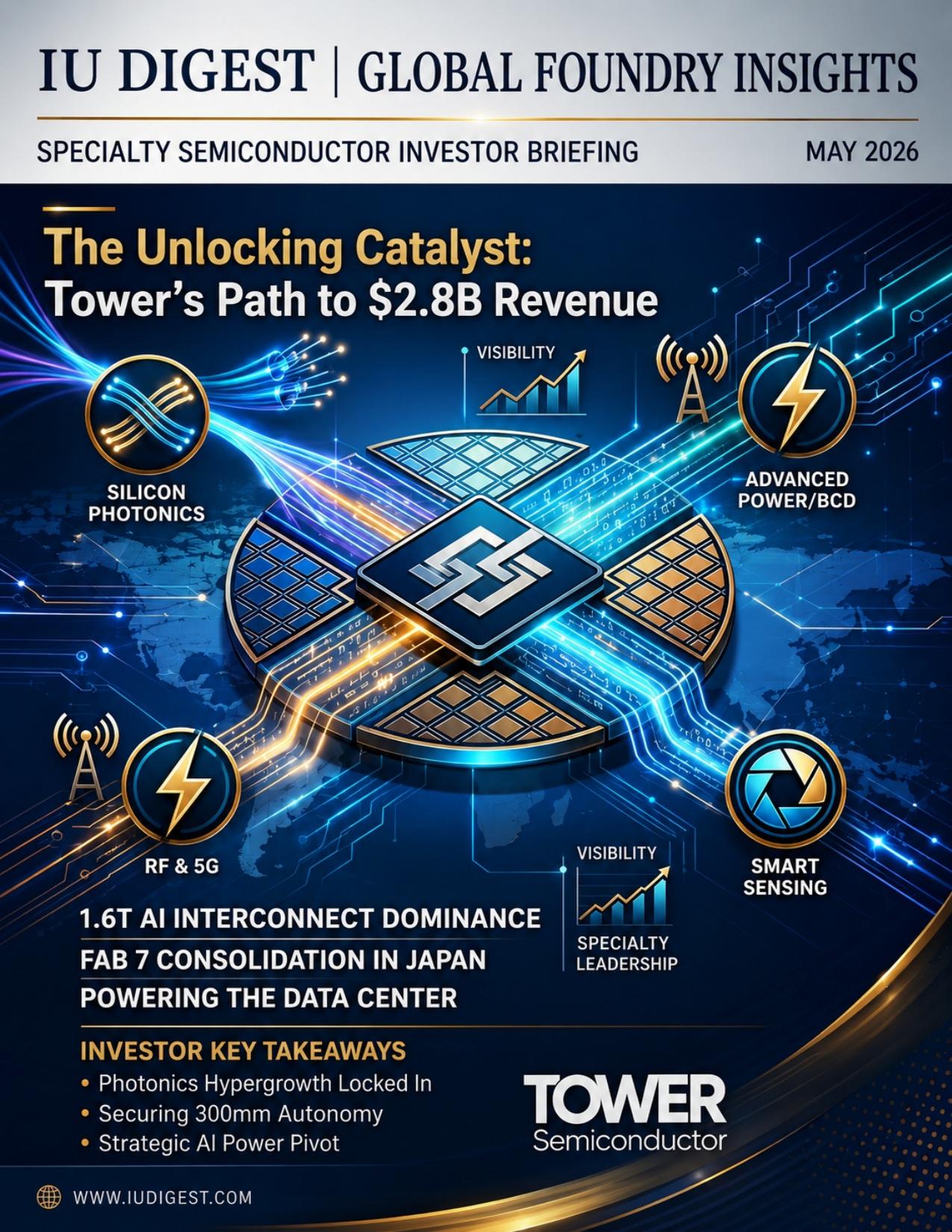
Tower Semiconductor is an analog/mixed-signal foundry at an inflection point — silicon photonics contracts, AI co-packaged optics demand, and prepayment structures signal accelerating conviction from hyperscaler customers. A 6-page institutional deep-dive into the $2.8B revenue thesis.
6-page institutional newsletter covering Tower Semiconductor's Q1 2026 earnings, Q2 guidance ramp toward ~$455M, the $1.3B silicon photonics contract for 2027 delivery, $290M in customer prepayments, $920M CapEx program, and the structural path to $2.8B annual revenue. IU Specialty Semiconductor Series.
Tower Semiconductor (NASDAQ: TSEM) is a specialty analog and mixed-signal foundry operating at a structural inflection point. Unlike leading-edge logic fabs competing on node shrinkage, Tower differentiates through process specialization — serving power management, RF, imaging, and now silicon photonics applications that demand proprietary process expertise rather than raw transistor density.
The company's transition into silicon photonics (SiPho) represents the most significant demand shift in its operating history. As hyperscalers accelerate AI infrastructure investment, co-packaged optics and optical interconnects have moved from experimental to production-scale procurement — and Tower holds a rare combination of wafer-level integration expertise, process maturity, and available capacity that positions it to capture an outsized share of this structural demand wave.
Core Thesis: The $1.3B SiPho contract announced for 2027 delivery is not an isolated win. It is evidence of a broader customer conviction shift — from design qualification to long-duration capacity commitment backed by $290M in prepayments. The CapEx program, revenue trajectory, and reservation dynamics together frame a credible path from ~$414M quarterly run-rate to a $2.8B annual revenue target.
Tower's Q1 2026 revenue of $414M represented 15% year-over-year growth, outpacing both consensus estimates and management's own prior guidance range. The beat was broad-based across end markets, with SiPho contributions beginning to layer onto the company's established RF and power management revenue streams. Gross margin performance confirmed that the product mix shift toward higher-value specialty processes is translating into operating leverage rather than simple volume growth.
Management's Q2 2026 guidance of approximately $455M implies a sequential increase of approximately 10%, which — if achieved — would establish a new quarterly record and validate the ramp trajectory embedded in the $2.8B revenue model. The sequential guidance bridge relies primarily on continued SiPho volume ramp and sustained demand from power management customers tied to AI server supply chains.
The $1.3B silicon photonics contract targeting 2027 delivery is the structural centerpiece of Tower's near-term thesis. SiPho wafers integrate optical components — lasers, modulators, photodetectors — directly with CMOS electronics on a single substrate, enabling the ultra-low-latency, high-bandwidth optical interconnects that next-generation AI accelerators require. Co-packaged optics, in which optical engines are packaged adjacent to AI processors rather than in discrete transceivers, demands wafer-level integration precision that Tower's process portfolio is specifically designed to deliver.
The contract structure is notable for what it reveals about customer intent. Delivery scheduled for 2027 implies that the customer has already completed — or is in final stages of — process qualification, tooling alignment, and yield validation. Contracts of this duration and scale are not signed speculatively; they reflect a customer's determination that Tower is the preferred production-scale partner for a strategic component of their AI infrastructure roadmap.
The $290M in customer prepayments is arguably the most underappreciated data point in Tower's current financial profile. Foundry prepayments — in which customers transfer cash to a manufacturer in exchange for guaranteed capacity reservations — represent a qualitatively different demand signal than order backlog or design win announcements. They indicate that the customer has assessed forward capacity risk, concluded that it is material, and made a binding financial commitment to secure production access.
In the context of Tower's $920M CapEx expansion program, the prepayment structure also functions as partial risk transfer. The customer's advance funding reduces Tower's net CapEx exposure while simultaneously locking in the revenue base that will absorb the new capacity. This dynamic — customer-funded capacity expansion — is structurally favorable and uncommon outside of leading-edge logic foundry relationships, making its appearance in Tower's business a meaningful signal of how customers view its strategic importance.
Tower's $920M CapEx program is targeted at expanding capacity across its specialty process platforms, with SiPho and RF capacity receiving the largest incremental allocations. The timeline aligns with the 2027 SiPho delivery commitment and the broader 2028 revenue bridge to $2.8B, making the investment cycle a necessary — rather than discretionary — precondition for hitting the long-term model.
The 70%+ capacity reservation through 2028 is the most forward-looking demand indicator in Tower's disclosed metrics. Reservation rates at this level, extending three-plus years into the future, suggest that customers are not merely signaling interest but actively managing supply risk by locking in production slots ahead of anticipated demand. For a specialty foundry operating in a process-differentiated niche, sustained reservation rates above 70% effectively constrain near-term downside while providing the revenue visibility needed to justify continued CapEx deployment.
Tower's primary competitive frame in the SiPho and specialty analog segments differs materially from the leading-edge logic foundry competition. The relevant peer set includes GlobalFoundries and Skywater Technology — both of which serve specialty process markets but lack Tower's specific combination of photonic integration depth, RF BiCMOS maturity, and established hyperscaler qualification history.
The structural moat in specialty foundry — as distinct from leading-edge logic — is process qualification depth and customer switching cost. Once a hyperscaler qualifies a supplier's photonic integration process for production, switching cost is extraordinarily high: re-qualification requires 12–24 months of engineering work, yield optimization, and supply chain realignment. Tower's SiPho production partnership, once fully established, is likely to be durable across multiple product generations.
The $2.8B annual revenue target implies approximately 70% growth from the current ~$1.65B annualized run-rate. The bridge relies on three compounding drivers: SiPho contract ramp contribution through 2027–2028 delivery, organic growth in existing RF, power, and imaging end markets driven by AI server and automotive demand, and capacity utilization improvement as the $920M CapEx program comes online and is absorbed by the 70%+ reservation base.
Revenue Bridge Components: (1) SiPho contract ramp: ~$400–500M incremental annual contribution at full delivery rate; (2) RF/power/imaging organic growth: mid-single-digit to low-double-digit CAGR on existing base; (3) Capacity utilization improvement: new fab buildout absorbed by pre-committed reservations. Combined, these vectors support the $2.8B target without requiring speculative new contract wins beyond those already disclosed.
Risk factors to the revenue bridge include execution risk in the SiPho ramp (yield qualification timelines, customer demand durability), CapEx deployment timing relative to production commitments, and the broader geopolitical environment affecting semiconductor supply chain investment decisions. Tower's Israel-based fab operations introduce an additional geopolitical risk dimension that is not present for U.S.-domiciled peers — a consideration that institutional investors weight variably but which warrants explicit attention in scenario modeling.

Subscribe for every future issue — institutional-grade research on specialty semiconductors, memory markets, macro, and real assets.
No investment advice. Research only. Unsubscribe anytime.