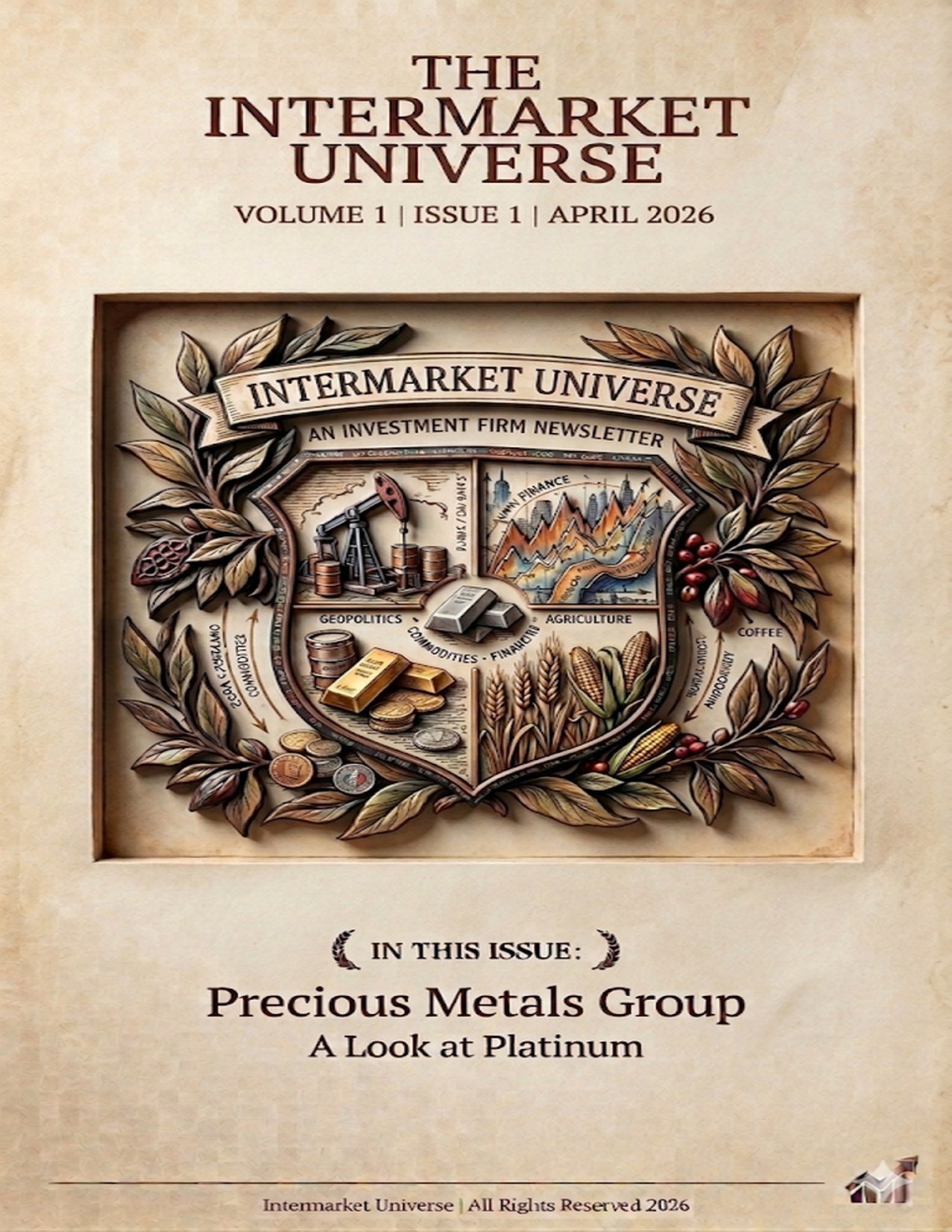
Precious Metals · Commodities · Macro

Platinum Group Metals: Strategic Research Edition — Vol. 1, Issue 1

April 2026 · Volume 1 · Issue 1 · 20 min read · Intermarket Universe
~$2,000
Platinum Price / oz
↑ Multi-Year High
3 yrs
Consecutive Supply Deficits
2023–2026
PGMs
Platinum Group Metals
Strategic Allocation
CHF
Gold Correlation Play
Safe-Haven Linkage

Volume 1 | Issue 1 | April 2026

IN THIS ISSUE

I. The Macro-Economic and Geopolitical Architecture

II. Supply Side Analysis: The Fragility of Primary Production

III. Demand Dynamics: Automotive and Industrial Resilience

IV. Above-Ground Stocks and Market Mechanics

V. Geopolitical Risks and Trade Policy Impacts

VI. Technical and Price Attribution Analysis

VII. Strategic Investment Recommendations

VIII. Conclusion: The New Platinum Era

EXECUTIVE SUMMARY The global platinum market has undergone a fundamental transformation between 2023 and early 2026, transitioning from a period of perceived surplus and price stagnation to one of acute physical scarcity and record-breaking valuation. The culmination of three consecutive years of massive supply-demand deficits has resulted in the most significant depletion of above-ground stocks in modern history, fundamentally altering the mechanics of price discovery. The current consolidation around US$2,000 per ounce reflects not a waning of fundamentals, but a consolidation phase before the next leg of a multi-year bull cycle expected to persist through 2027.

Volume 1 | Issue 1 | April 2026

I. THE MACRO-ECONOMIC AND GEOPOLITICAL ARCHITECTURE

The current state of the platinum market cannot be decoupled from the broader fracturing of the global geopolitical landscape. Throughout 2025 and into 2026, several macropolitical factors have converged to drive investor sentiment toward precious metals as strategic hedges. The "Sell America" trade, characterized by the underperformance of the Dow Jones Industrial Average relative to the MSCI World Index (ex-US), has encouraged institutional rotation into hard assets. This trend has been amplified by trade policy uncertainty in the United States, specifically the Section 232 investigation into critical minerals and subsequent investigations by the US International Trade Commission into Russian palladium imports.

The uncertainty surrounding US trade measures has kept a significant volume of platinum "onshore" within CME-approved warehouses, effectively withdrawing liquidity from the global market and supporting elevated lease rates. This behavior reflects a structural change in how industrial end-users manage supply chain risk in a volatile policy environment. Furthermore, the launch of platinum and palladium futures on the Guangzhou Futures Exchange (GFEX) in late 2025 has introduced a new pole of price discovery, enabling Chinese market participants to hedge in local currency and further tightening the physical availability of metal in Western vaults.

Table 1: Historical and Forecast Platinum Market Balances (koz)

Year Total Supply Total Demand Market Balance AGS

2022 7,378 6,287 +1,092 5,543

2023 7,135 7,822 -688 4,855

2024 7,303 8,224 -921 3,935

2025 7,215 8,297 -1,082 2,853

2026f 7,379 7,619 -240 2,613

Source: Metals Focus 2019–2026f, WPIC Q4 2025

The cumulative deficit between 2023 and 2025 reached nearly 2.7 million ounces, representing a massive withdrawal from the vaulted buffer. The 2025 deficit of 1,082 koz was the largest in the WPIC time series dating back to 2013, driven by a 65% surge in investment demand that more than offset a cyclical low in industrial offtake.

Volume 1 | Issue 1 | April 2026

II. SUPPLY SIDE ANALYSIS: THE FRAGILITY OF PRIMARY PRODUCTION

The platinum supply profile is heavily concentrated, with South Africa accounting for approximately 70% of global mine output. This geographic concentration introduces systematic vulnerabilities, as the global market balance is essentially a function of South African operational consistency and energy availability.

South Africa: The Crisis of the Western Limb In April 2026, leading executives in the South African PGM sector issued stark warnings regarding the long-term viability of the industry. Northam Platinum CEO Paul Dunne described the industry as having entered a phase of "terminal decline," projecting a 10% reduction in national output over the next five years. This assessment is rooted in the physical reality of the Western Limb of the Bushveld Complex, where ore bodies have become increasingly deep and geologically complex.

The mining environment is defined by escalating costs and infrastructure bottlenecks. While Eskom has reported improvements in its generation fleet—achieving an Energy Availability Factor of 65.38% in April 2026—this remains below the levels required to support aggressive production expansion. The financial burden of deep-level mining continues to grow, with cooling costs accounting for nearly 30% of operating expenses at depths exceeding 3 km.

In response, the "Big Three" producers have engaged in massive right-sizing. Impala Platinum reduced its Rustenburg shaft count from eleven to six between 2023 and 2025. Sibanye-Stillwater has transitioned into a "survival phase," while the newly demerged Valterra Platinum has signaled that new greenfield investments would require a sustained platinum price of US$2,500 per ounce to justify capital risk.

North American and Russian Supply Constraints Supply outside of South Africa offers little prospect for meaningful near-term ramp-up. North American primary production hit a series low of 209 koz in 2025, a 21% year-on-year decline, driven by Sibanye-Stillwater's restructuring of US operations and structural decline of byproduct economics in Canadian nickel mining. In Russia, production has remained relatively stable at 676 koz in 2025, but future output is threatened by the ongoing withdrawal of Western equipment suppliers.

The Limits of Recycling Elasticity While secondary supply from recycling is traditionally the market's swing factor, it has recently proven less elastic than expected. Total recycling is forecast to grow by 10% in 2026 to reach 1,827 koz, but several bottlenecks persist: the global vehicle park is aging, high financing costs limit smaller collectors, and platinum-rich vehicles from the mid-2000s have largely been recycled.

Table 2: Projected Mine Supply by Region (koz)

Volume 1 | Issue 1 | April 2026

Region 2024 2025 2026f YoY Change

South Africa 4,133 3,965 4,010 +1%

Zimbabwe 512 502 518 +3%

North America 265 209 192 -8%

Russia 677 676 637 -6%

Others 191 198 195 -1%

Source: WPIC Platinum Quarterly, April 2026

Regional Supply Profiles South Africa (4,010 koz forecast, +1% YoY): The dominant global supplier's modest recovery masks deeper structural fragility. Output from the Western Limb continues its secular decline as shafts close and depths exceed 3 km. The marginal uptick is largely attributable to Mogalakwena and Northern Limb operations, which benefit from shallower, mechanized extraction. Eskom load-shedding, while improved, remains an ongoing risk to production consistency, and above-inflation wage settlements continue to compress margins across the sector.

Zimbabwe (518 koz forecast, +3% YoY): The only major producer showing meaningful growth, driven by expansions at Zimplats and Mimosa. The Great Dyke formation offers comparatively shallow, lower-cost ore bodies attracting capital redeployed from South Africa's Western Limb. However, sovereign risk, currency volatility, and infrastructure constraints place a ceiling on near-term expansion.

North America (192 koz forecast, -8% YoY): The steepest regional decline continues, as platinum is predominantly a byproduct of palladium and nickel mining. Sibanye-Stillwater's Montana operations have undergone significant restructuring, while Canada's nickel price downturn has curtailed Sudbury Basin output. No new greenfield projects are under development.

Russia (637 koz forecast, -6% YoY): Nornickel remains the sole significant producer, concentrated in Norilsk-Talnakh. The withdrawal of Western equipment suppliers has forced a shift to less efficient Chinese and domestic alternatives. Declining ore grades at mature deposits compound these challenges, with management guiding toward continued contraction through 2027.

Others (195 koz forecast, -1% YoY): Smaller producers across Finland, Colombia, and emerging jurisdictions remain flat. Exploration-stage assets in Botswana and Greenland show long-term promise but are unlikely to contribute meaningful supply before 2030.

Volume 1 | Issue 1 | April 2026

III. DEMAND DYNAMICS: AUTOMOTIVE AND INDUSTRIAL RESILIENCE

A persistent misconception in the platinum market has been the narrative of terminal demand destruction due to the electrification of the global transport fleet. Current data suggests that these fears were misjudged, as the demand for platinum-containing internal combustion engines and hybrid vehicles has proven remarkably durable.

The Hybrid Pivot and Substitution Effects As of early 2026, global automakers have begun to rebalance their portfolios in response to slowing demand for pure battery electric vehicles. Hybrids have emerged as the consumer "sweet spot," offering improved efficiency without range anxiety. This shift is highly supportive of platinum demand, as hybrid vehicles require sophisticated catalytic converters with PGM loadings often higher than traditional ICE vehicles. Furthermore, the substitution of platinum for palladium in gasoline engine catalysts has become a structural demand pillar, expected to exceed 1 million ounces annually by 2025–2026.

The Hydrogen Economy: A Multi-Decade Demand Tail The most compelling long-term demand driver is platinum's essential role in the hydrogen economy. Platinum catalysts are used in PEM electrolyzers to produce green hydrogen and in hydrogen fuel cells for mobility and stationary applications. While hydrogen-related demand is currently nascent at an estimated 65 koz in 2025, it is projected to reach nearly 900 koz by 2030. The 2026–2027 period marks a critical deployment phase, with major PEM electrolyzer projects transitioning from final investment decisions to construction and operation.

Table 3: Sector-Specific Platinum Demand Projections (koz)

Sector 2025 2026f 2027f 2030f

Automotive 3,035 2,943 3,000+ ~2,800

Jewellery 2,190 1,927 ~2,000 ~2,200

Industrial 1,915 2,124 ~2,250 ~2,400

Hydrogen 65 69 ~120 875

Investment 1,157 625 ~800 ~700

Source: Composite projections based on WPIC and Metals Focus data

Volume 1 | Issue 1 | April 2026

Industrial and Jewellery Demand Outlook

Industrial demand for platinum is expected to reach record levels through 2027, underpinned by the synchronized expansion of the chemical, glass, and petroleum refining sectors. Collectively, these industries represent a broad and diversified demand base that has proven resilient to macroeconomic headwinds and is increasingly anchored to long-term structural growth trends rather than short-term cyclical fluctuations.

Glass Sector Recovery and Expansion: The global glass industry is emerging from a cyclical trough that characterized much of 2024 and early 2025. New manufacturing capacity for LCD panels, OLED substrates, and fibreglass insulation is being commissioned across China, India, and Southeast Asia. Platinum-lined bushings essential to high-quality glass fibre production require significant PGM loadings—typically 200 to 400 ounces per line. As new facilities come online throughout 2026 and 2027, the glass sector is projected to add an incremental 80–120 koz of annual demand, reversing the contraction seen during the prior capacity rationalization cycle.

Chemical and Petroleum Refining: Platinum catalysts remain indispensable in the production of nitric acid, silicone compounds, and specialty chemicals. With food security concerns driving investment in agricultural inputs, nitric acid capacity additions in the Middle East and North Africa are expected to underpin steady industrial offtake. In petroleum refining, platinum-based reforming catalysts are seeing renewed demand as Asian refineries upgrade to process heavier crude grades and meet tighter fuel quality specifications mandated by IMO 2025 regulations.

Sustainable Aviation Fuel (SAF): Perhaps the most consequential emerging industrial demand channel is the production of sustainable aviation fuel. Platinum catalysts are integral to the Fischer-Tropsch and HEFA pathways used to convert biomass and waste oils into jet-grade fuel. With IATA targeting 10% SAF blending by 2030 and the European Union mandating 6% usage under its ReFuelEU Aviation initiative, the scale-up of SAF refining infrastructure represents a multi-decade demand tailwind. Early estimates suggest SAF-related platinum consumption could reach 50–75 koz annually by 2030, with further growth as global production scales toward 2050 net-zero targets.

Jewellery Demand — Structural Rebalancing: Jewellery fabrication remains a critical pillar of the platinum demand architecture, accounting for approximately 25% of annual global consumption. While higher prices in 2026 have led to a volume pullback in price-sensitive markets such as mainland China, this has been partially offset by growing adoption in India and Japan, where major retail chains are promoting platinum bridal collections to the millennial and Gen-Z demographic. Platinum's widening discount to gold—currently exceeding US$1,000 per ounce—has made it a compelling value proposition for high-end gem-set jewellery. The Platinum Guild International projects a modest recovery in fabrication volumes through 2027 as consumer expectations adjust to the new price baseline.

Volume 1 | Issue 1 | April 2026

IV. ABOVE-GROUND STOCKS AND MARKET MECHANICS

The exhaustion of Above-Ground Stocks is the defining technical feature of the 2026–2027 outlook. By the end of 2025, cumulative deficits had eroded AGS to an estimated 2.85 million ounces, representing just over four months of global demand cover—the lowest level in the WPIC time series. With another deficit forecast for 2026, AGS are expected to decline further to 2.61 million ounces by year-end.

Table 4: Cumulative Deficit Impact on Above Ground Stocks (koz)

Year Annual Balance Year-End AGS Months Cover

2022 (Actual) +1,092 5,543 10.6

2023 (Actual) -688 4,855 7.4

2024 (Actual) -921 3,935 5.7

2025 (Estimated) -1,082 2,853 4.1

2026 (Forecast) -240 2,613 4.1

Source: WPIC data and analyst assessments

Lease Rates: The Shadow Price of Scarcity The implied one-month platinum lease rate averaged 12% in 2025, compared to just 1% in 2024. During periods of acute tightness in mid-2025, lease rates surged as high as 36%. In response, large automotive OEMs and chemical processors have pivoted away from leasing toward direct ownership to secure long-term supply chains—creating a self-reinforcing cycle of tightness as metal is withdrawn from the liquid market.

Backwardation and Futures Pricing Persistent backwardation throughout 2025 and early 2026 signals that immediate demand outweighs demand for future delivery. The launch of GFEX has added a new dimension, with initial premiums reaching US$270 per ounce above international benchmarks. As GFEX begins publishing daily warehouse stock data in mid-2026, transparency of inventory levels in the world's largest consuming market will likely increase global price sensitivity to supply disruptions.

Volume 1 | Issue 1 | April 2026

V. GEOPOLITICAL RISKS AND TRADE POLICY IMPACTS

Section 232 and Strategic Stockpiling

The US administration's Section 232 investigation into processed critical minerals concluded in early 2026 without immediate tariffs on PGMs. However, a 180-day negotiation window—closing in July 2026—has been initiated to establish price floors and trade agreements. The potential for future tariffs or quotas has encouraged US-based companies to keep platinum onshore, maintaining elevated CME warehouse stocks. Should negotiations fail, tariff imposition in late 2026 or 2027 could trigger a surge in strategic government and private sector stockpiling.

The USITC Russian Palladium Investigation A significant spillover risk for platinum is the ongoing USITC investigation into Russian palladium imports. Preliminary determinations have established anti-dumping duty rates of 132.83% and CVD subsidy rates of 109.10%, for a combined preliminary tariff exceeding 241%. A final ruling is expected in June 2026. Because palladium and platinum are mutually substitutable in many automotive applications, a major palladium supply shock would likely accelerate rotation into platinum-heavy catalytic converters, further supporting the structural bull case.

VI. TECHNICAL AND PRICE ATTRIBUTION ANALYSIS

The Gold-to-Platinum Catch-Up Trade Historically, platinum has traded at a premium to gold. Since 2015, this relationship has reversed, with the gold-to-platinum ratio reaching 2.4:1 in early 2026. The investment thesis for 2027 rests heavily on mean reversion. If the ratio normalizes toward 1.5:1 or 1:1, platinum prices would need to rise substantially even if gold prices remain flat. Technical analysis of XPT/USD as of April 2026 shows strong support in the US$2,050 range, with conservative 2027 estimates suggesting US$2,438 and optimistic institutional projections reaching US$3,000.

Table 5: Institutional Price Projections for Platinum (US$/oz)

Institution 2026f (Avg) 2027f (High) Rationale

Bank of America 2,450 2,700 Supply / Geopolitics

Reuters Poll 2,400 2,425 Structural deficits

TD Securities 2,063 2,500 Debasement trade

WalletInvestor 2,297 2,438 Mean reversion

Metals Focus 1,670 1,800+ ETF profit taking

Source: Compiled from various institutional reports, Q1 2026

Volume 1 | Issue 1 | April 2026

VII. STRATEGIC INVESTMENT RECOMMENDATIONS

The combination of structural deficits, critical inventory depletion, and the emergence of the hydrogen economy creates a compelling asymmetric opportunity for investors in the 2026–2027 window. Tactical allocation should consider three primary vehicles:

1. Physically Backed ETFs (Institutional Standard) — For investors seeking liquid, low-cost exposure to the spot price without logistical risks of physical storage, physically backed ETFs represent the optimal entry point.

2. Physical Bullion (Strategic Diversification) — Physical ownership in coins and bars is increasingly popular among retail investors in China and Japan as a hedge against currency debasement and systemic financial risk.

3. PGM Mining Equities (Leveraged / High Beta) — Investing in producers offers potential for outsized returns but carries significant operational, energy, and labor risks associated with the South African and North American mining environments.

VIII. CONCLUSION: THE NEW PLATINUM ERA

The platinum market has entered a structural "New Era" where the historical reliance on above-ground inventory buffers has been exhausted. The outlook for late 2026 through 2027 is one of persistent deficit, high lease rates, and continued price appreciation as the supply-side response remains constrained by the terminal decline of legacy mines in South Africa.

The re-basing of the platinum price to a floor above US$2,000 per ounce reflects the reality of a market that is no longer behaving like a cyclical industrial commodity but rather like a critical mineral essential to the global energy transition. For the strategic investor, the next 24 months represent a critical window of opportunity to capitalize on the widening valuation gap between gold and platinum and the accelerating deployment of hydrogen-based industrial technologies.

Disclaimer: This report is published by Intermarket Universe for educational and informational purposes only. It does not constitute financial, investment, or trading advice. Commodity markets carry substantial risk of loss. Past performance is not indicative of future results. Always consult a qualified financial advisor before making investment decisions.


This research is for informational purposes only and does not constitute investment advice. Intermarket Universe does not hold positions in any securities mentioned unless disclosed.