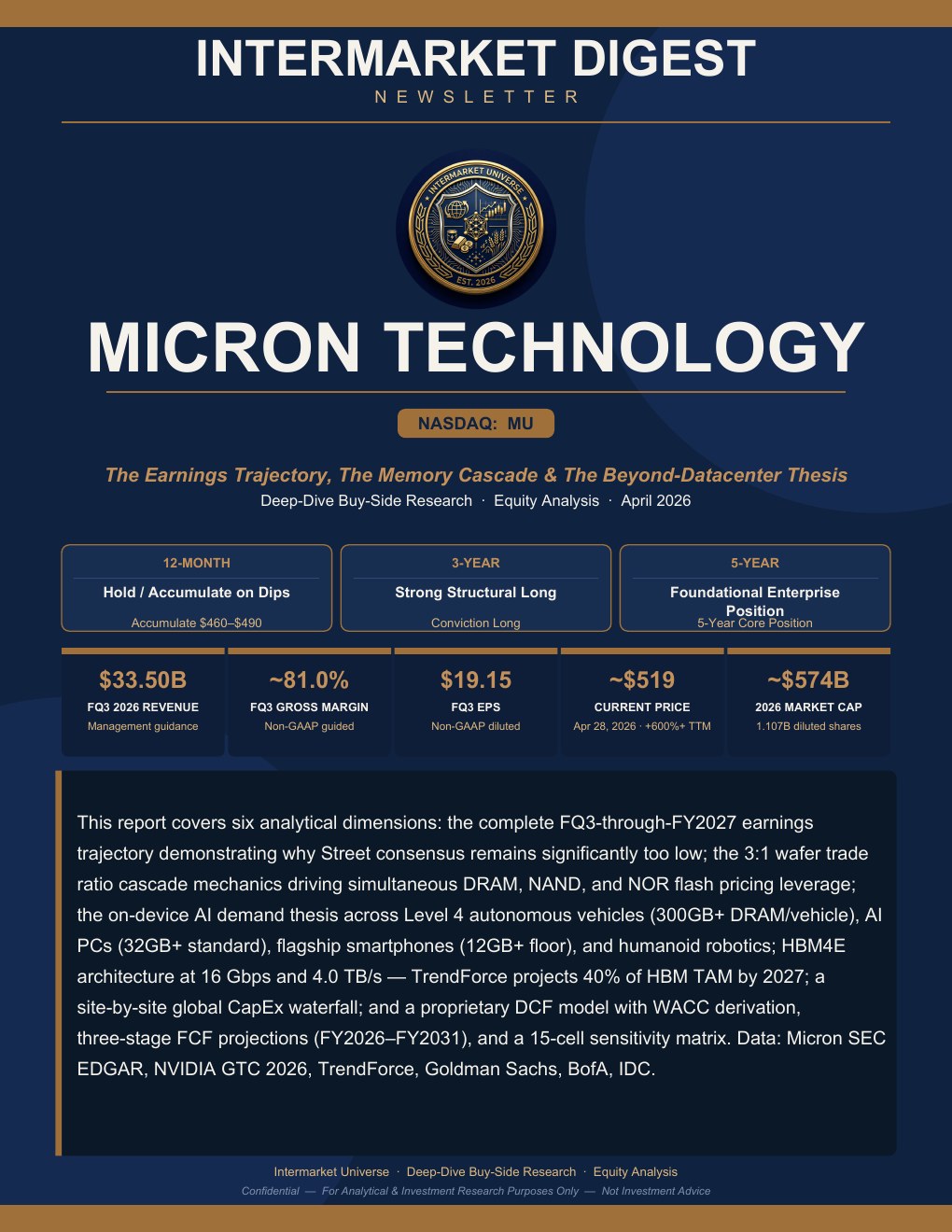
MICRON TECHNOLOGY
From Silicon to Solutions:
Powering the AI Era
An institutional-grade analysis of memory manufacturing, AI-driven demand dynamics, record financial performance, and the structural transformation of the global semiconductor supply chain.
AI-Era Market Intelligence Report Micron Technology — AI-Era Market Intelligence Report March 2026
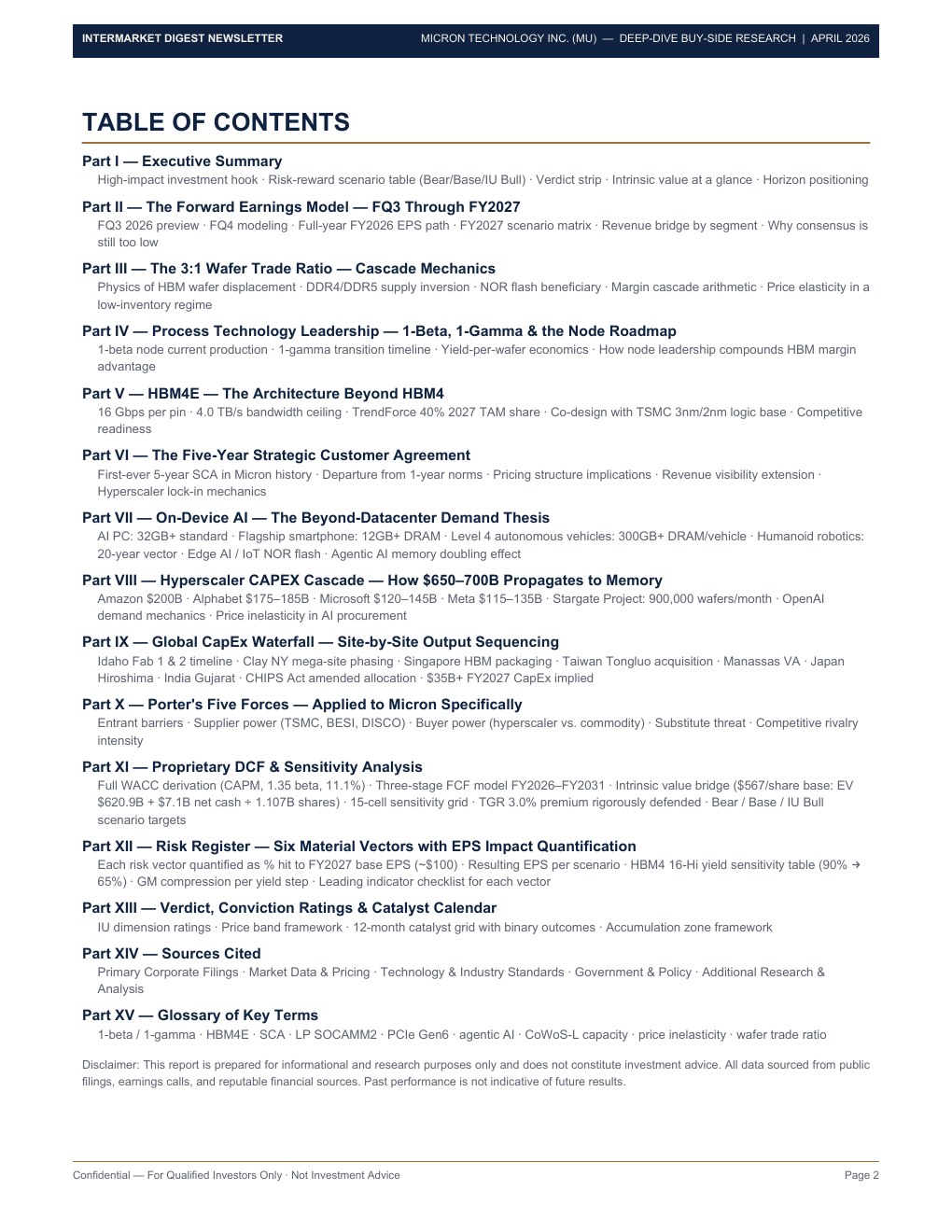
Table of Contents
I. The Memory Bottleneck — Infographic Overview
II. Micron Technology: Company Profile & Core Technology Portfolio
III. The AI Value Engine — How Demand Reshapes Supply
IV. Record FQ2 Performance & Expansion Roadmap — Infographic
V. FQ2 FY2026: The Financial Climax
VI. High-Bandwidth Memory — The Center of Gravity
VII. The Structural DRAM Shortage & Hyperscaler Demand
VIII. Capital Expenditure & Global Manufacturing Expansion
IX. CHIPS Act, Geopolitics & Regulatory Landscape
X. Competitive Landscape: Samsung, SK Hynix & the HBM Race
XI. On-Device AI: Beyond the Data Center
XII. Risk Assessment & Cyclical Considerations
XIII. Conclusion: The Foundational Engine of the AI Economy
Disclaimer: This newsletter is prepared for informational and research purposes only. It does not constitute investment advice, a recommendation, or an offer to buy or sell any securities. All data is sourced from public filings, earnings calls, and reputable financial news outlets. Past performance is not indicative of future results. The memory semiconductor industry is cyclical and subject to significant volatility.
Page 2 Confidential — For Research Purposes Only
I. The Memory Bottleneck: AI Leverage & the Global DRAM Shortage
Figure 1: The global memory market has entered an unprecedented supply shortage driven by hyperscale AI data center buildouts. Micron's 2026 HBM supply is fully sold out, with DRAM prices surging over 110% quarter-over-quarter.
Page 3 Micron Technology — AI-Era Market Intelligence Report March 2026
Infographic Context: The Memory Bottleneck The infographic above captures the central thesis of this report: the global memory market has entered an unprecedented period of structural shortage driven by the extraordinary multi-year data center buildout by hyperscale cloud providers. This is not a typical cyclical upturn — it is a fundamental reordering of semiconductor economics.
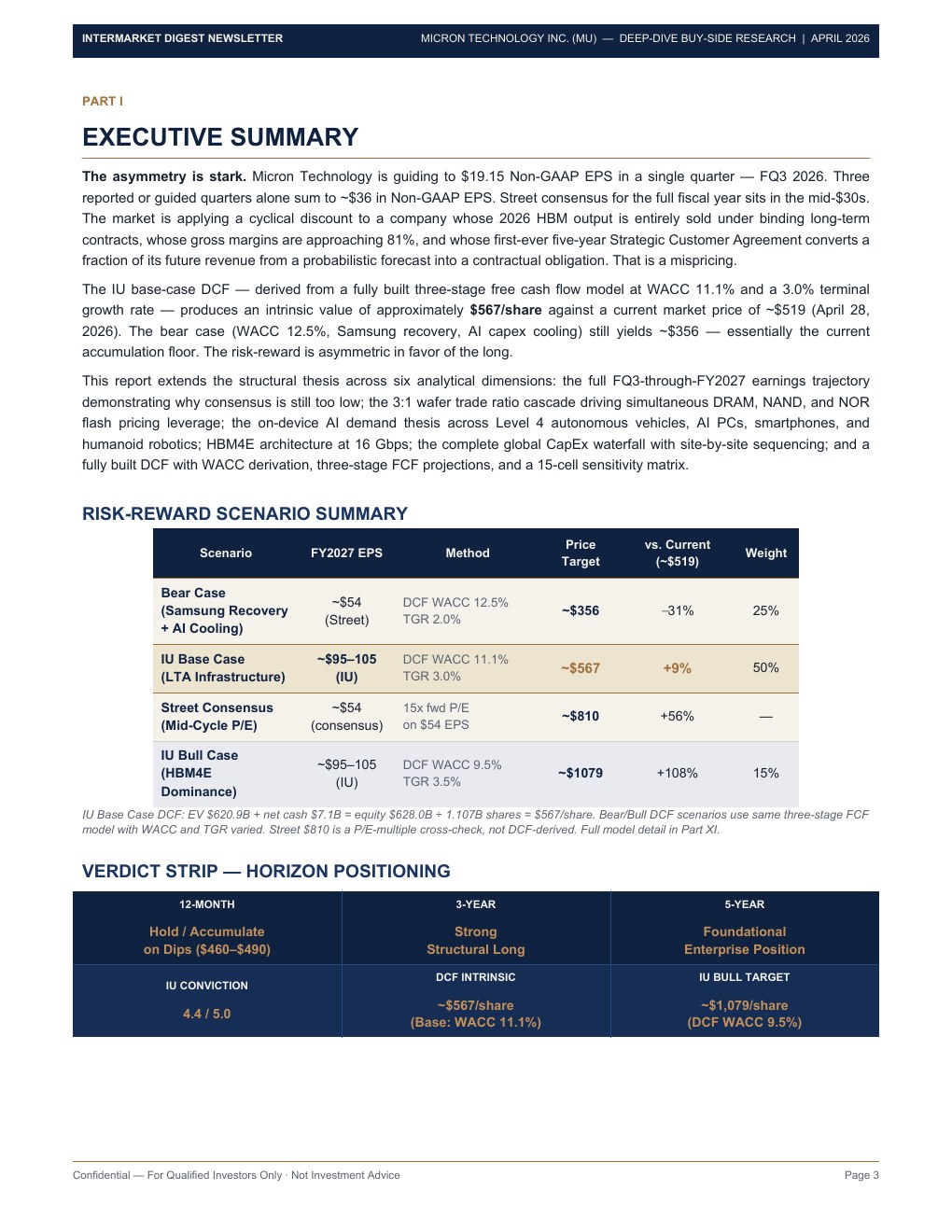
Several key data points stand out. PC DRAM prices have surged up to 110% in a single quarter, reflecting the cascading effect of manufacturers reallocating wafer capacity from conventional products to AI-optimized High-Bandwidth Memory (HBM). The four largest hyperscalers — Amazon, Google, Microsoft, and Meta — are securing memory supply at nearly any price, with combined 2026 AI infrastructure spending approaching $650–700 billion. Micron's entire 2026 HBM production is sold out, and the company can fulfill only 50–67% of customer demand. This supply tightness is projected to persist through at least 2028, when new fab capacity from Idaho and Samsung's P4/P5 lines begins contributing meaningful output.
The comparison table within the infographic illustrates the magnitude of Micron's transformation. In fiscal year 2023 — the industry downturn — Micron posted $15.54 billion in full-year revenue with negative 9% gross margins and $7.68 billion in annual CapEx. By contrast, in a single quarter of FQ2 2026, the company generated $23.86 billion in revenue (exceeding the entire FY2023 by 53%), with gross margins expanding to 74.9% and annual CapEx now projected to exceed $25 billion.
II. Micron Technology: Company Profile & Core
Technology Portfolio Micron Technology, Inc. (NASDAQ: MU) is one of the world's largest manufacturers of semiconductor memory and storage solutions, headquartered in Boise, Idaho. Founded in 1978, the company has grown into a global enterprise with over 48,000 employees, manufacturing facilities across the United States, Japan, Singapore, Taiwan, and India, and more than 60,000 active patents protecting its intellectual property portfolio.
Micron's products serve as the foundational physical layer upon which virtually all modern computing operates. Every smartphone, laptop, server, autonomous vehicle, and AI accelerator requires memory to function. As artificial intelligence transitions from a software paradigm to a hardware-constrained reality, Micron's role has elevated from commodity supplier to strategic infrastructure provider — a company whose products are now as critical to AI as GPUs themselves.
The Core Technology Portfolio Micron produces three fundamental categories of memory, each serving distinct but complementary roles in the computing ecosystem. Understanding these technologies is essential to grasping why AI has restructured the entire memory industry.
DRAM (Dynamic Random Access Memory)
DRAM is volatile memory — it loses data when power is removed — designed for high-speed data retrieval and low-latency processing. It serves as the working memory for virtually every computing device, from PCs and
Page 4 Confidential — For Research Purposes Only Micron Technology — AI-Era Market Intelligence Report March 2026
smartphones to data center servers. In Q1 FY2026, DRAM generated $10.81 billion in revenue (79% of total), making it Micron's dominant product line. DRAM is manufactured using advanced photolithography processes in cleanroom environments 100× cleaner than hospital operating rooms, with wafers moving through hundreds of chemical and UV exposure steps over a month-long fabrication cycle. Micron is currently producing on 1-beta and 1-gamma DRAM technology nodes, among the most advanced in the industry.
NAND Flash Memory
NAND is non-volatile storage — it retains data without power — used for high-capacity, cost-effective storage in SSDs, mobile devices, and consumer electronics. While less revenue-intensive than DRAM ($2.74 billion in Q1 FY2026), NAND plays a critical role in the AI ecosystem by providing the storage layer for training datasets, model checkpoints, and inference caching. AI data centers require petabytes of high-speed SSD storage alongside their DRAM and HBM stacks. Micron's latest product innovations include PCIe Gen6 SSDs designed specifically for the bandwidth demands of AI workloads, announced at NVIDIA GTC 2026.
High-Bandwidth Memory (HBM)
HBM represents the intersection of DRAM technology and advanced 3D packaging. It stacks multiple DRAM die vertically — currently 8 to 16 layers — connected by thousands of through-silicon vias (TSVs), then bonds this stack directly onto an AI accelerator using advanced packaging techniques. The result is memory that delivers bandwidth exceeding 2.8 TB/s (in HBM4) with significantly lower power consumption per bit than conventional DRAM. HBM is essential for both AI training and inference because large language models and other neural networks require massive amounts of data to be fed to GPU cores simultaneously. Without sufficient HBM bandwidth, even the most powerful GPU sits idle waiting for data.
The 3:1 Trade Ratio: Producing one unit of HBM consumes approximately three times the wafer capacity and cleanroom footprint of conventional DDR5 DRAM. This means every gigabyte of HBM produced directly reduces the available supply of standard memory, creating a cascading price effect across the entire DRAM portfolio. As AI demand drives more production toward HBM, conventional DRAM supply tightens, prices rise industry-wide, and margins expand for all memory products — not just HBM itself.
NOR Flash Memory
NOR flash ($88 million in Q1 FY2026 revenue) is a smaller but strategically important product line providing fast-read, reliable code storage for automotive, industrial, and IoT applications. As vehicles become increasingly autonomous and connected, NOR flash demand grows with each additional electronic control unit (ECU) and sensor system.
The Memory Manufacturing Journey Manufacturing memory is among the most complex industrial processes ever devised. Each chip begins with R&D design backed by 60,000+ patents, where engineers use CAD tools to lay out billions of nanoscale electronic components. The wafer then enters fabrication — a month-long process where AMHS robotic systems move silicon wafers between hundreds of chemical and UV exposure steps. Photolithography coats wafers with photoresistant material, exposes circuit patterns with ultraviolet light, applies compounds to create circuit layers, and rinses away excess — repeating this cycle to build hundreds of identical die per wafer. After
Page 5 Confidential — For Research Purposes Only Micron Technology — AI-Era Market Intelligence Report March 2026
fabrication, wafers are thinned, cut with diamond-edge saws, and functionally tested. Passing die are bonded to circuit boards with gold wire, encapsulated in protective plastic, mounted onto printed circuit boards (DIMMs or SSDs), and subjected to extreme heat and performance stress tests before shipping.
III. The AI Value Engine — How Demand Reshapes
Supply Artificial intelligence has transitioned from being a standard system component to a defining strategic asset that has fundamentally recast the demand for memory and storage. Within the semiconductor industry, AI is the primary force accelerating demand growth at a rate that currently outpaces the industry's ability to increase supply. This creates what Micron's management describes as an "unprecedented gap" between demand and available capacity.
The mechanism operates as a self-reinforcing cycle with four stages:
Stage Driver Effect
Data centers and edge devices require 1. Insatiable AI Demand Demand growth outpaces supply massive leaps in memory bandwidth
Micron allocates premium fab capacity 2. Advanced Node Shift Product mix shifts to higher value toward HBM and high-capacity DIMMs
3. Industry Supply HBM consumes 3× wafer capacity of Overall bit supply tightens Constriction conventional DRAM
Superior pricing execution and 4. Margin Expansion Supply constraints meet rising demand record profitability
This cycle is why Micron's gross margins have expanded from negative 9% in the FY2023 downturn to 74.9% in FQ2 2026 — a swing of nearly 84 percentage points in just three years. The structural nature of AI demand means this is not merely a cyclical recovery but a fundamental repricing of memory's value within the technology stack.
Segment-Specific AI Demand Drivers Data Center & Hyperscale Cloud: This is the primary engine. Hyperscale cloud providers are engaged in an extraordinary multi-year buildout of AI data centers requiring significantly higher quantities of DRAM, HBM, and NAND. The HBM total addressable market is projected to grow from approximately $35 billion in 2025 to $100 billion by 2028. Data centers are projected to exceed 50% of the industry bit TAM for the first time in 2026. Combined 2026 capital expenditure from Amazon, Google, Microsoft, and Meta approaches $650–700 billion, with roughly 75% directed at AI infrastructure.
Client (PC & Mobile): The rise of "agentic AI" — where AI agents perform tasks independently on-device — is doubling recommended memory specifications for PCs to at least 32GB of RAM. In the smartphone market, flagship devices are increasingly shipping with 12GB or more of DRAM, with nearly 80% of flagship mix at this level by Q4 2025.
Page 6 Confidential — For Research Purposes Only Micron Technology — AI-Era Market Intelligence Report March 2026
Intelligent Edge, Automotive & Robotics: AI is supercharging robotics, which Micron views as a 20-year growth vector. Level 4 autonomous vehicles are expected to require over 300GB of DRAM per vehicle. AI-enabled humanoid robots require compute platforms with memory and storage capacities rivaling high-end automobiles. Micron launched its LP SOCAMM2 module at GTC 2026 specifically for these edge AI platforms.
Page 7 Confidential — For Research Purposes Only
IV. Record FQ2 Performance & Global Expansion Roadmap
Figure 2: Micron's AI-Fueled Ascent — FQ2 2026 records across revenue ($23.86B), EPS ($12.20), and 196% YoY growth, with FQ3 guidance of $33.50B revenue at ~81% gross margins.
Page 8 Micron Technology — AI-Era Market Intelligence Report March 2026
Infographic Context: The AI-Fueled Ascent The second infographic maps Micron's explosive financial trajectory alongside its domestic manufacturing expansion roadmap. The 75% sequential revenue growth from $13.64 billion in FQ1 to $23.86 billion in FQ2 is unprecedented in semiconductor history for a company of this scale. Non-GAAP EPS more than doubled from $4.78 to $12.20 in a single quarter. The FQ3 2026 outlook — $33.50 billion in revenue, ~81% gross margins, and $19.15 diluted EPS — would represent a single quarter that exceeds the full-year revenue of every fiscal year in Micron's history prior to FY2024.
The U.S. manufacturing expansion timeline shows three concurrent construction nodes: Idaho Fab 1 (first wafer output mid-2027), Idaho Fab 2 (end of 2028), and the Clay, New York mega-site (groundbreaking January 2026, operational 2029–2030). This represents the largest domestic memory manufacturing buildout in American history, supported by $6.4 billion in CHIPS Act grants and a long-term $200 billion investment commitment.
V. FQ2 FY2026: The Financial Climax
On March 18, 2026 — just two days before this report's publication — Micron reported the most dominant earnings beat in its 47-year history. Revenue of $23.86 billion crushed consensus estimates by nearly $4 billion. Non-GAAP EPS of $12.20 exceeded Street expectations of ~$9. The company set simultaneous records for revenue, gross margin (74.9%), operating margin (69.0%), operating cash flow ($11.9 billion), and adjusted free cash flow ($6.9 billion).
FQ3 FY26 Metric FQ4 FY25 FQ1 FY26 FQ2 FY26 (Guidance)
Revenue $11.32B $13.64B $23.86B $33.50B
Non-GAAP Gross 45.7% 56.8% 74.9% ~81.0% Margin
Non-GAAP EPS ~$3.53 $4.78 $12.20 $19.15
Operating Cash Flow $5.73B $8.41B $11.90B —
Free Cash Flow — — $6.90B —
Every business segment delivered records. Cloud memory revenue reached $7.75 billion, mobile and client hit $7.71 billion (up from $2.24 billion a year earlier), and automotive/embedded delivered $2.71 billion. DRAM revenue of $18.8 billion comprised 79% of total, with average selling prices climbing in the mid-60s percentage range quarter-over-quarter. NAND ASPs surged in the high-70s percentage range sequentially.
Page 9 Confidential — For Research Purposes Only Micron Technology — AI-Era Market Intelligence Report March 2026
Key Milestone: FQ3 2026 revenue guidance of $33.5 billion would exceed the full-year revenue of every fiscal year in Micron's history prior to FY2024. CEO Sanjay Mehrotra emphasized this point explicitly on the earnings call. The board approved a 30% quarterly dividend increase, reflecting confidence in sustained strength.
Balance sheet improvements were equally significant. Micron reduced long-term debt by over $5 billion in three quarters, bringing the balance to $9.6 billion against $16.7 billion in cash and investments. The company is simultaneously de-leveraging while funding the largest capital expenditure program in memory industry history.
VI. High-Bandwidth Memory — The Center of
Gravity HBM has transformed from an emerging opportunity into the primary growth engine of the semiconductor memory industry. At NVIDIA's GTC 2026 on March 16, Micron confirmed high-volume production of HBM4 36GB 12-Hi designed for NVIDIA's Vera Rubin GPU platform. This next-generation memory delivers over 11 Gb/s pin speeds and bandwidth exceeding 2.8 TB/s — a 2.3× improvement over HBM3E. The company has also shipped HBM4 48GB 16-Hi samples to customers, offering 33% more capacity per GPU placement.
HBM Market Projections Year HBM TAM Key Drivers
2025 ~$35 Billion HBM3E ramp for Blackwell / MI350X
2026 ~$55 Billion HBM4 production begins; Vera Rubin
2027 ~$75 Billion HBM4E enters mass production
2028 $100 Billion Full HBM4E deployment at scale
All of Micron's HBM capacity is sold out through calendar year 2026, with substantial 2027 volumes pre-booked. Management stated the company can fulfill only 50–67% of customer demand in the medium term. In a landmark shift, Micron signed its first-ever five-year Strategic Customer Agreement — a significant departure from the industry's typical one-year contracts that signals customers are locking in long-term supply security at premium pricing.
Technical Innovation: HBM4 and Beyond HBM4 introduces a fundamentally new architecture. Unlike HBM3E, which uses a standardized logic base die, HBM4 features a custom logic base die manufactured by TSMC that can be co-designed with specific GPU architectures. This creates tighter integration between memory and compute, reducing latency and improving power efficiency. The next generation, HBM4E, extends this concept with 16 Gbps per pin speeds and up to 4.0 TB/s bandwidth. TrendForce projects HBM4E will account for roughly 40% of total HBM demand in 2027. Micron also announced PCIe Gen6 SSDs and the LP SOCAMM2 memory module at GTC 2026, addressing the
Page 10 Confidential — For Research Purposes Only Micron Technology — AI-Era Market Intelligence Report March 2026
full memory hierarchy for AI systems.
VII. The Structural DRAM Shortage & Hyperscaler
Demand The demand side of Micron's equation is arguably even more compelling than the supply story. Combined 2026 capital expenditure guidance from the four largest hyperscalers has reached $650–700 billion, up 60–70% from 2025. Amazon leads at approximately $200 billion, followed by Alphabet at $175–185 billion, Microsoft at $120–145 billion, and Meta at $115–135 billion. Bank of America notes hyperscalers are expected to spend roughly 90% of operating cash flow on capex in 2026, up from 65% in 2025.
Structural vs. Cyclical: Unlike typical memory cycle recoveries, the current shortage stems from deliberate reallocation of wafer capacity toward HBM, which consumes 3× the wafer area of standard DDR5 per gigabyte. This is a physics-driven constraint, not a demand forecast error. DRAM prices have surged 171% year-over-year, with DDR5 spot prices quadrupling since September 2025 to $38 per 16Gb chip. IDC projects 2026 DRAM supply growth of just 16% YoY, well below demand growth.
Data centers are expected to consume 70% of all memory chips produced in 2026. OpenAI's Stargate project alone has contracted for up to 900,000 wafers of DRAM per month — roughly 40% of global output. TrendForce estimates the total memory market will reach $551.6 billion in 2026 and surge to $842.7 billion in 2027. AI demand is proving price inelastic — hyperscalers continue purchasing at scale regardless of pricing. Goldman Sachs projects DRAM prices will rise double-digit percentages quarter-over-quarter throughout every quarter of 2026.
VIII. Capital Expenditure & Global Manufacturing
Expansion Micron's FY2026 capital expenditure guidance has been revised sharply upward twice: from an original ~$18 billion to $20 billion at FQ1 earnings (December 2025), and now to over $25 billion at FQ2 earnings — a 40% increase in just two quarters and an 80% jump from FY2025's $13.8 billion. FQ2 alone saw $6.4 billion in gross CapEx, with FQ3 projected at approximately $7 billion.
Global Manufacturing Footprint Location Investment Focus Timeline
Idaho (Fab 1) ~$25B combined Leading-edge DRAM First wafer mid-2027
Idaho (Fab 2) (two fabs) Leading-edge DRAM Operational end-2028
Page 11 Confidential — For Research Purposes Only Micron Technology — AI-Era Market Intelligence Report March 2026
Location Investment Focus Timeline
Groundbreaking Jan 2026; Fab 1 Clay, New York Up to $100B Mega-site (4 fabs) ~2029-2030
1-alpha DRAM Manassas, VA $2.17B Underway (auto/defense)
Singapore Multi-billion HBM adv. packaging Ramping by 2027
Acquired Mar Taiwan (Tongluo) Cleanroom from PSMC Accelerated timeline 2026
Japan Modernization Future DRAM nodes Ongoing (Hiroshima)
India (Gujarat) New facility Assembly & test Full ramp 2026
The CapEx intensity is what spooked the market post-earnings — shares dropped 5–7% despite the blowout results. However, management signaled FY2027 construction-related CapEx alone will increase by more than $10 billion year-over-year, implying total FY2027 CapEx potentially in the $35 billion+ range. Micron is investing at unprecedented scale because it sees a decade-long structural demand curve that justifies building capacity that will not produce wafers for two to four years. The broader $200 billion long-term investment commitment aims to produce 40% of Micron's DRAM in the United States by the 2040s.
IX. CHIPS Act, Geopolitics & Regulatory
Landscape Micron has secured $6.44 billion in total CHIPS Act direct funding: $6.165 billion for Idaho and New York (finalized December 2024) plus $275 million for Manassas, Virginia (finalized June 2025). In FQ2 FY2026 alone, Micron received $1.378 billion in government incentive proceeds ($2.256 billion in H1 FY2026 total). The company also benefits from a 35% investment tax credit on qualifying manufacturing equipment.
Notably, Micron amended its CHIPS agreement to redirect approximately $1.2 billion from New York to Idaho, accelerating the Boise fab timeline. Despite initial hostile rhetoric from the Trump administration toward the CHIPS Act, the administration pivoted to take credit for Micron's expansions. Commerce Secretary Lutnick confirmed streamlined policy requirements while finalizing the Virginia funding.
Geopolitical Risk Factors China's Cyberspace Administration (CAC) cybersecurity review has restricted Micron's access to the Chinese market for certain products. Export controls on advanced AI-capable memory products continue to limit market opportunities. Supply chain reliance on rare earth metals, concentrated in China, poses an ongoing risk. The broader U.S.-China technology decoupling creates both risk (lost China revenue) and opportunity (government incentives and reshoring demand).
Page 12 Confidential — For Research Purposes Only Micron Technology — AI-Era Market Intelligence Report March 2026
X. Competitive Landscape: Samsung, SK Hynix &
the HBM Race
Metric SK Hynix Micron Samsung
HBM Revenue Share ~57% ~21% ~22%
(Q3'25)
Mass production (NVIDIA High-volume production Mass production (11.7 HBM4 Status Rubin) (NVIDIA Vera Rubin) Gbps)
P4/P5 fab expansion; $15.1B M15X fab + $13B $25B+ FY26 CapEx; Major Investment HBM capacity packaging plant $200B long-term U.S. doubling
Vertically integrated; First-mover in HBM; Fastest share gain (4% → Key Advantage largest overall highest market share 21% in 1 year) capacity
SK Hynix remains the dominant HBM supplier with roughly 57% revenue share, but its lead is narrowing as Micron's share surged from approximately 4% to 21% in a single year. Samsung, after an 18-month struggle to qualify HBM3E with NVIDIA, finally passed qualification in September 2025 and announced HBM4 mass production at GTC 2026 with industry-leading 11.7 Gbps pin speeds. All three vendors are investing tens of billions in new HBM and advanced packaging capacity, confirming this is not a temporary demand spike but a structural industry transformation.
XI. On-Device AI: Beyond the Data Center
While data center demand dominates headlines, AI is simultaneously transforming memory requirements across every end market. "Agentic AI" — where AI agents perform complex tasks independently on local devices — represents a paradigm shift that doubles or triples memory content per device.
Segment AI Memory Requirement Growth Driver
AI PCs 32GB+ RAM (2× prior standard) Agentic AI, on-device LLMs
Flagship Smartphones 12GB+ DRAM (80% of mix) On-device AI processing
Level 4 Autonomous 300GB+ DRAM per vehicle Sensor fusion, real-time inference Vehicles
Humanoid Robots Rivaling high-end auto 20-year growth vector per Micron
Edge AI / IoT Growing NOR + DRAM content Connected sensors, industrial AI
Page 13 Confidential — For Research Purposes Only Micron Technology — AI-Era Market Intelligence Report March 2026
These on-device trends compound with data center demand to create a multi-front memory demand surge. Micron's mobile and client segment already grew from $2.24 billion to $7.71 billion in a single year, and management expects AI PC adoption to accelerate further as Windows 12 and next-generation macOS increasingly require AI-capable hardware configurations.
XII. Risk Assessment & Cyclical Considerations
Despite the extraordinary momentum, the memory semiconductor industry remains brutally cyclical. Investors and analysts must weigh several material risks against the current boom:
CapEx Execution Risk: At $25 billion+ in FY2026 and potentially $35 billion+ in FY2027, any delays in fab construction, equipment delivery, or yield ramps could pressure returns on invested capital. Fab construction is among the most complex engineering projects in existence — Micron's Idaho facility required 70,000 tons of American-made steel and daily dynamite blasting of basalt foundation.
Demand Materialization Risk: If AI demand does not materialize at the forecasted pace, the massive investments in new factories could lead to future oversupply and high fixed costs from depreciation. The memory industry has historically overbuilt during booms, leading to devastating downturns. However, the current five-year customer agreements and sold-out HBM order books mitigate this risk more than in prior cycles.
Geopolitical Risk: China CAC restrictions, export controls on AI-capable products, rare earth supply chain dependencies, and evolving trade policy under the Trump administration all create uncertainty. Micron's ongoing IP litigation (Netlist, YMTC) adds further legal exposure.
Valuation and Market Sentiment: Micron shares dropped 5–7% after the blowout earnings report — a classic "sell the news" reaction driven by CapEx concerns and peak-margin fears. The stock's 52-week range of $61.54 to $471.34 reflects extreme volatility. Analyst consensus is Strong Buy with targets from $450 (Morgan Stanley, Barclays) to $700 (Cantor Fitzgerald), with a mean around $536.
XIII. Conclusion: The Foundational Engine of the AI
Economy Micron's March 2026 earnings report represents a fundamental inflection point for the memory industry. Three key insights define the current landscape:
First, the AI memory supercycle is accelerating, not plateauing. FQ3 guidance of $33.5 billion in a single quarter with 81% gross margins demolishes the bear case that memory is peaking. The company signed its first five-year strategic agreement, signaling a structural shift away from commodity-cycle pricing.
Second, the DRAM shortage is structural rather than cyclical, driven by the physics of HBM production consuming 3× the wafer area of conventional chips. No meaningful new supply arrives before 2028. Hyperscaler spending of $650–700 billion ensures demand remains price-inelastic.
Page 14 Confidential — For Research Purposes Only Micron Technology — AI-Era Market Intelligence Report March 2026
Third, Micron's competitive position has never been stronger. HBM market share surged from 4% to 21% in a single year, HBM4 volume production is confirmed for NVIDIA Vera Rubin, and the company's $200 billion U.S. manufacturing commitment — backed by $6.4 billion in CHIPS Act grants — positions it as a national security asset.
“Artificial Intelligence is not just a software revolution; it is fundamentally constrained by physical memory. By translating nanoscale R&D into unparalleled HBM supply, scaling a $25 billion global fab footprint, and delivering record 75% margins, Micron is no longer just a participant in the semiconductor cycle — it is the foundational engine of the AI economy.”
Report compiled: March 20, 2026 | Sources: Micron Q1 & Q2 FY2026 earnings calls, SEC Form 8-K filings, NVIDIA GTC 2026 announcements, CNBC, TrendForce, IDC, Investing.com, Motley Fool, InfotechLead, Markets Daily, Construction Dive, NIST.gov, and sell-side analyst reports.
Page 15 Confidential — For Research Purposes Only
This research is for informational purposes only and does not constitute investment advice. Intermarket Universe does not hold positions in any securities mentioned unless disclosed.