Energy · Oil & Gas · Macro

Hydrocarbon Industry Fundamental Breakdown

2026 Edition · Research Notes · 40 min read · Intermarket Universe
8
Sections Covered
Full Industry Map
3
Industry Segments
Up / Mid / Downstream
OPEC
vs U.S. Dynamics
Supply & Pricing
2026
Energy Transition
Updated Outlook

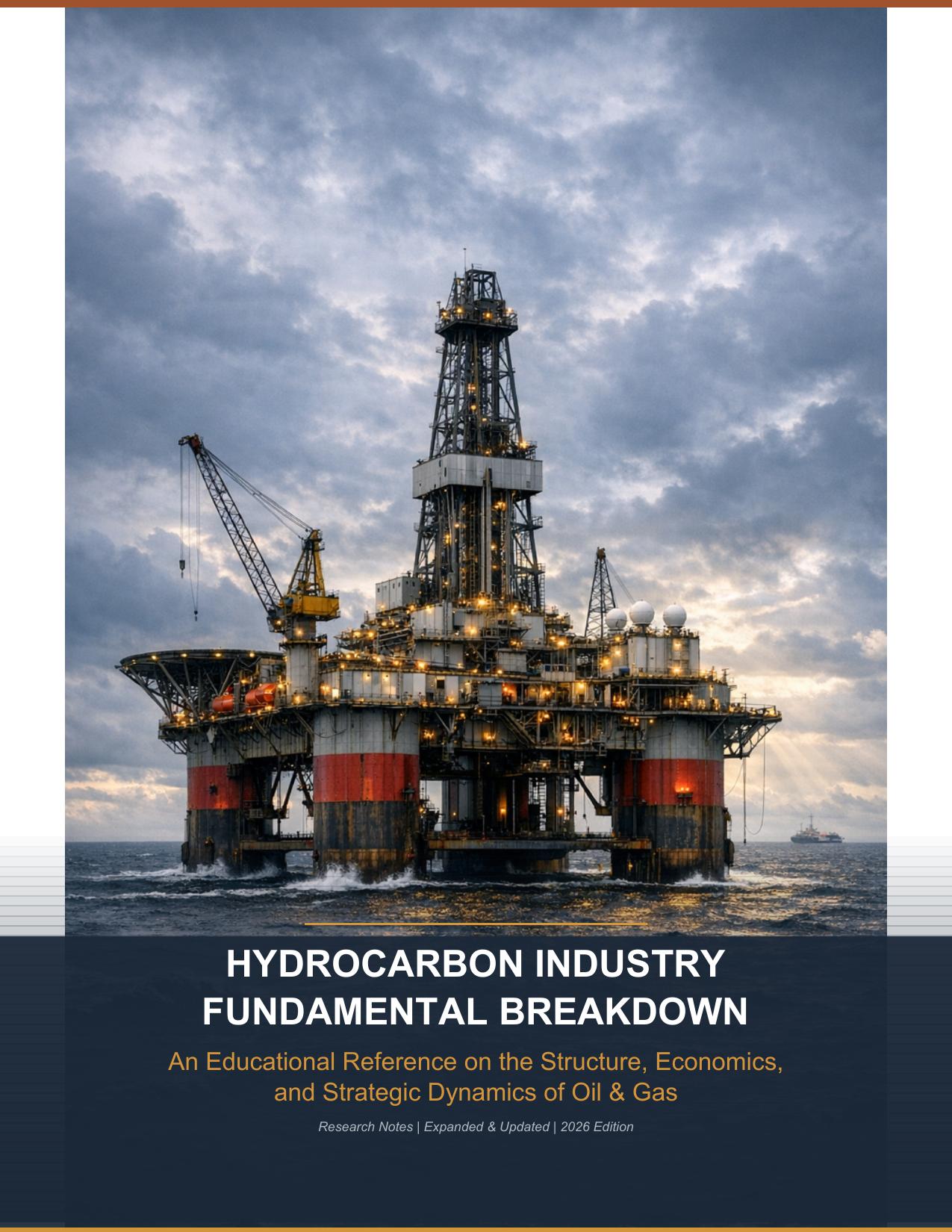
HYDROCARBON INDUSTRY FUNDAMENTAL BREAKDOWN An Educational Reference on the Structure, Economics, and Strategic Dynamics of Oil & Gas Research Notes | Expanded & Updated | 2026 Edition HYDROCARBON INDUSTRY | FUNDAMENTAL BREAKDOWN Page 2

TABLE OF CONTENTS

Section 1 — Hydrocarbons: Foundation of the Energy Economy

Section 2 — Industry Structure: Upstream, Midstream, Downstream

Section 3 — Rig Utilization Rate & Drilling Economics

Section 4 — Key Financial Metrics for Oil & Gas Analysis

Section 5 — Hydraulic Fracturing (Fracking)

Section 5-B — The Domestic Drilling Revolution

Section 6 — OPEC vs. U.S. Oil Market Dynamics

Section 7 — Energy Transition & Future Outlook

Section 8 — Glossary of Essential Terms

Educational Reference | For Informational Purposes Only HYDROCARBON INDUSTRY | FUNDAMENTAL BREAKDOWN Page 3

SECTION 01

Hydrocarbons: Foundation of the Energy Economy

Hydrocarbons are organic chemical compounds composed exclusively of hydrogen and carbon atoms. They serve as the molecular backbone of the global energy system, forming the basis of crude oil, natural gas, and coal. These substances originated from ancient plant and animal organisms that were subjected to immense heat and pressure over millions of years beneath the Earth’s surface — a process known as diagenesis and catagenesis.

Formation & Geology Hydrocarbons accumulate in porous rock formations — typically sandstone, limestone, and shale — found deep below the Earth’s surface and often beneath large bodies of water. Immense quantities are trapped beneath the ocean floor on continental shelves. When hydrocarbons migrate upward and become trapped beneath an impermeable cap rock layer (such as clay or salt), an oil and gas reservoir is formed. Extraction involves drilling through the cap rock and into the reservoir to release the trapped fluids.

Types of Hydrocarbons Type Examples Primary Use State at STP

Methane, Ethane, Alkanes (Paraffins) Heating, cooking, fuel Gas / Liquid Propane, Butane

Cycloalkanes Cyclohexane, Industrial solvents, Liquid (Naphthenes) Cyclopentane feedstock

Benzene, Toluene, Petrochemicals, Aromatics Liquid Xylene plastics

Alkenes (Olefins) Ethylene, Propylene Plastics manufacturing Gas

Educational Reference | For Informational Purposes Only HYDROCARBON INDUSTRY | FUNDAMENTAL BREAKDOWN Page 4

Economic Significance

~80% ~100M $3.3T+

Est. Global Oil & Gas Revenue Share of Global Energy Consumption Barrels of Oil Consumed Daily (Annual)

Hydrocarbon fuels include gasoline, diesel, jet fuel, heating oil, and liquefied petroleum gas (LPG). Beyond combustion, hydrocarbons are the primary feedstock for the petrochemical industry, which produces plastics, synthetic fibers, fertilizers, pharmaceuticals, and thousands of other essential products.

Educational Reference | For Informational Purposes Only HYDROCARBON INDUSTRY | FUNDAMENTAL BREAKDOWN Page 5

SECTION 02

Industry Structure: Upstream, Midstream, Downstream

The oil and gas industry is conventionally divided into three interconnected segments. Each carries a distinct risk profile, capital intensity, and revenue model. Understanding this segmentation is critical to evaluating companies, interpreting financial statements, and identifying investment opportunities.

Upstream (Exploration & Production — E&P) Upstream companies are responsible for locating and extracting hydrocarbons from underground reservoirs. This segment is the most capital-intensive and carries the highest risk, as exploration efforts may yield dry holes with zero return. Key activities include seismic surveying, exploratory drilling, well completion, and production management.

  • High technology costs for seismic data acquisition, deepwater rigs, and directional

drilling systems.

  • Most cash flow and income statement line items are directly tied to oil and gas

production volumes and commodity prices.

  • E&P companies often contract drilling companies (e.g., Helmerich & Payne, Nabors

Industries) to perform the actual drilling.

  • Well maintenance and servicing — including logging, cementing, casing,

perforating, and fracturing — is largely outsourced to oilfield services companies (e.g., Halliburton, Schlumberger, Baker Hughes).

Key Players: ExxonMobil (XOM) • Chevron (CVX) • ConocoPhillips (COP) • EOG Resources (EOG) • Pioneer Natural Resources (PXD) • Devon Energy

(Dvn)

Educational Reference | For Informational Purposes Only HYDROCARBON INDUSTRY | FUNDAMENTAL BREAKDOWN Page 6

Midstream (Transportation & Storage) Midstream companies bridge the gap between extraction and processing by transporting crude oil, natural gas, and natural gas liquids (NGLs) from wellheads to refineries and processing plants. This segment is characterized by relatively stable, fee-based revenue models that are less sensitive to commodity price swings than upstream operations.

  • Infrastructure includes pipelines, gathering systems, compressor stations, tanker

fleets, rail terminals, and underground storage facilities.

  • Many midstream companies operate as Master Limited Partnerships (MLPs) or

C-corps, offering attractive distribution yields.

  • Lower capital risk relative to E&P, with long-term take-or-pay contracts providing

revenue visibility.

Key Players: Enterprise Products Partners (EPD) • Kinder Morgan (KMI) • Williams Companies (WMB) • Energy Transfer (ET) • MPLX LP (MPLX)

Downstream (Refining & Marketing) Downstream encompasses the refining of crude oil into finished petroleum products and their distribution to end consumers. Refineries convert raw hydrocarbons into gasoline, diesel, jet fuel, heating oil, lubricants, asphalt, and petrochemical feedstocks. The marketing side includes wholesale distribution, retail gas stations, and branded fuel networks.

  • Profitability is driven by the crack spread — the margin between the cost of crude

oil and the selling price of refined products.

  • Refineries require massive capital investment and operate on tight margins, making

capacity utilization a critical metric.

  • Integrated majors (e.g., ExxonMobil, Shell) operate across all three segments,

providing natural hedging against commodity volatility.

Key Players: Valero Energy (VLO) • Marathon Petroleum (MPC) • Phillips 66 (PSX) • HF Sinclair (DINO) • PBF Energy (PBF)

Educational Reference | For Informational Purposes Only HYDROCARBON INDUSTRY | FUNDAMENTAL BREAKDOWN Page 7

SECTION 03

Rig Utilization Rate & Drilling Economics

The rig utilization rate measures the number of oil drilling rigs actively in use as a percentage of a company’s total available fleet. It is one of the most closely watched indicators in the oilfield services sector and serves as a barometer for both company-level profitability and the broader macroeconomic health of the energy industry.

Why Rig Utilization Matters

  • Higher utilization rates translate directly to higher revenue and improved fixed-cost

absorption for drilling contractors.

  • When demand is robust, utilization rates can exceed 90%, signaling potential

capacity constraints and the need for fleet expansion or new rig construction.

  • During economic downturns, reduced oil demand leads to lower rig counts,

depressed day rates, and cold-stacking of inactive rigs.

  • The Baker Hughes Rig Count, published weekly, is the industry’s benchmark

measure of active drilling rigs in the U.S. and internationally.

Day Rates & Contract Structures Drilling contractors charge operators a day rate — the daily rental fee for a drilling rig and crew. Day rates fluctuate based on supply-demand dynamics, rig specifications, and contract duration. Premium rigs with advanced capabilities (e.g., AC-drive systems, automated pipe handling, managed pressure drilling) command significantly higher day rates. During the 2014 downturn, offshore day rates plummeted from over $600,000/day for deepwater rigs to below $200,000/day. The post-2021 recovery pushed rates back toward the $400,000–$500,000 range for high-spec deepwater units.

Rig Types Typical Day Rate Rig Type Environment Key Consideration Range

Mobility, pad drilling Land Rig Onshore $15K – $35K/day capability

Educational Reference | For Informational Purposes Only HYDROCARBON INDUSTRY | FUNDAMENTAL BREAKDOWN Page 8

Typical Day Rate Rig Type Environment Key Consideration Range

Shallow water Jack-Up $80K – $150K/day Water depth limitation (<400 ft)

Semi-Submersi Deepwater Harsh environment $250K – $450K/day ble (1,000–10,000 ft) capability

Ultra-deepwater Drillship $350K – $500K/day Dual-activity, mobility (>5,000 ft)

Educational Reference | For Informational Purposes Only HYDROCARBON INDUSTRY | FUNDAMENTAL BREAKDOWN Page 9

SECTION 04

Key Financial Metrics for Oil & Gas Analysis

Evaluating companies across the oil and gas value chain requires a specialized set of financial and operational metrics. Standard equity valuation tools (P/E, EV/EBITDA) remain relevant, but must be supplemented with sector-specific measures that capture the unique economics of resource extraction and commodity-driven revenue.

Metric Definition Segment

Enterprise value divided by earnings before interest, EV/EBITDA All taxes, depreciation, and amortization

EV divided by debt-adjusted cash flow; normalizes EV/DACF Upstream for varying capital structures

Finding & development cost per BOE added to F&D Cost E&P reserves

Reserve New reserves added as a % of production — above E&P Replacement 100% indicates growth

Revenue per BOE minus royalties, production costs, Netback Upstream and transportation

Difference between crude input cost and refined Crack Spread Downstream product output price

Depreciation, depletion & amortization per barrel — DD&A per BOE Upstream reflects asset quality

Cash available for unitholder distributions after Distributable CF Midstream maintenance capex

Active rigs as a % of total fleet — proxy for demand Rig Utilization OFS and pricing power

Educational Reference | For Informational Purposes Only HYDROCARBON INDUSTRY | FUNDAMENTAL BREAKDOWN Page 10

Reading an E&P Income Statement Oil and gas exploration companies have distinctive financial statement structures. Revenue is driven by commodity prices multiplied by production volumes (reported in BOE or Mcfe). Major cost line items include lease operating expenses (LOE), DD&A, exploration expense (dry hole write-offs), and gathering/transportation fees. Impairment charges can be significant during commodity downturns when the carrying value of reserves exceeds their market value under ceiling test calculations.

Educational Reference | For Informational Purposes Only HYDROCARBON INDUSTRY | FUNDAMENTAL BREAKDOWN Page 11

SECTION 05

Hydraulic Fracturing (Fracking)

Hydraulic fracturing is a well stimulation technique in which high-pressure fluid is injected into a wellbore to create fractures in deep rock formations, allowing oil and natural gas to flow more freely to the surface. Combined with horizontal drilling, fracking has unlocked vast unconventional resources in shale formations that were previously uneconomical to extract, fundamentally reshaping the global energy landscape.

The Fracking Process Step 1 — Well Drilling: A vertical wellbore is drilled to the target formation depth (typically 5,000–15,000 feet), then turned horizontally to traverse the productive shale layer for 1–2 miles laterally.

Step 2 — Perforation: Shaped explosive charges create small holes in the well casing and surrounding cement, establishing communication between the wellbore and the reservoir rock.

Step 3 — Fluid Injection: A slurry of water (~90%), proppant sand (~9.5%), and chemical additives (~0.5%) is pumped at extreme pressures (5,000–15,000 psi) to fracture the rock.

Step 4 — Propping: The proppant (typically frac sand or ceramic beads) holds the fractures open after pressure is released, creating permanent pathways for hydrocarbon flow.

Step 5 — Flowback & Production: Pressure is relieved and the well begins producing oil and/or gas along with flowback water, which must be managed and disposed of properly.

Frac Sand — A Critical Input Frac sand (high-purity silica sand) is an essential proppant in the fracturing process. The quality of sand — including grain shape, crush resistance, and mesh size — directly impacts well productivity. The Permian Basin’s emergence as a dominant production region drove the development of in-basin sand mines in West Texas, significantly

Educational Reference | For Informational Purposes Only HYDROCARBON INDUSTRY | FUNDAMENTAL BREAKDOWN Page 12

reducing logistics costs. Major U.S. producers have historically included companies like U.S. Silica Holdings (SLCA), Hi-Crush, and Covia Holdings.

Key Shale Formations Formation Location Primary Product Significance

West TX / SE New Largest U.S. producing Permian Basin Oil & Gas Mexico basin

Oil, Gas, High-quality light sweet Eagle Ford South Texas Condensate crude

North Dakota / Pioneered U.S. shale Bakken Light Crude Oil Montana revolution

Appalachia (PA, Marcellus Natural Gas Largest U.S. gas field

Wv, Oh)

Louisiana / East Haynesville Dry Natural Gas LNG export feedstock Texas

Environmental Considerations Hydraulic fracturing has become one of the most debated energy practices in modern history, drawing sustained regulatory scrutiny across multiple environmental dimensions. While the technology has delivered transformative economic benefits, its environmental footprint requires careful management and ongoing mitigation efforts.

Water Usage & Management: A single horizontal well completion can require 4–16 million gallons of water, depending on formation depth, lateral length, and the number of fracturing stages. In arid regions like the Permian Basin, this demand competes with agricultural and municipal water supplies. The industry has responded by dramatically increasing water recycling rates — some Permian operators now recycle over 90% of produced water — and by developing brackish and non-potable water sourcing alternatives to reduce freshwater dependence.

Groundwater Contamination Risk: The primary concern involves the potential for fracturing fluids or methane to migrate into shallow aquifer zones. While the fracturing process itself occurs thousands of feet below drinking water aquifers, risks arise from

Educational Reference | For Informational Purposes Only HYDROCARBON INDUSTRY | FUNDAMENTAL BREAKDOWN Page 13

surface spills, wellbore integrity failures (inadequate casing or cementing), and improperly constructed or abandoned wells. Regulatory responses have included mandatory well casing standards, cement bond logging requirements, baseline water testing mandates, and chemical disclosure through platforms such as FracFocus.org.

Induced Seismicity: The deep-well injection of produced wastewater — distinct from the fracturing process itself — has been linked to increased seismic activity, most notably in Oklahoma, where earthquake frequency rose sharply between 2009 and 2015. Regulators implemented traffic-light protocols that require operators to reduce or halt injection when seismic thresholds are exceeded. Real-time seismic monitoring networks and injection volume limits have since reduced event frequency in the most affected areas.

Methane Emissions & Air Quality: Methane, the primary component of natural gas, is a potent greenhouse gas with roughly 80 times the warming potential of CO2 over a 20-year horizon. Emissions occur through venting, flaring, and fugitive leaks at wellheads, gathering systems, and processing facilities. The industry has adopted leak detection and repair (LDAR) programs, vapor recovery units, reduced-emission (green) completions, and pneumatic device replacements to minimize releases. Federal methane rules finalized in recent years have tightened requirements across the production and gathering segments.

Surface & Land Impact: Well pads, access roads, pipelines, and waste storage occupy significant acreage, fragmenting habitats and impacting ecosystems — particularly in sensitive areas like the Appalachian hardwood forests (Marcellus) and western rangelands. Multi-well pad drilling has reduced the overall surface footprint per well by allowing 20–40 wells to be drilled from a single location, and progressive reclamation practices restore disturbed land during the production phase rather than waiting until decommissioning.

Regulatory Landscape Jurisdiction Key Regulations Notable Provisions

Statewide Rule 13, Injection well permitting, disposal limits, Texas (RRC) H-10/H-1 permits seismic response

Educational Reference | For Informational Purposes Only HYDROCARBON INDUSTRY | FUNDAMENTAL BREAKDOWN Page 14

Jurisdiction Key Regulations Notable Provisions

Oklahoma Induced Seismicity Volume reduction/shut-in triggers based on (OCC) Traffic Light Protocol magnitude thresholds

Pennsylvania Chapter 78/78a Oil & Enhanced casing standards, setback (DEP) Gas Regulations distances, water testing

Colorado SB 19-181 Local government siting authority, 2,000-ft (ECMC) Implementation Rules setbacks from homes

NSPS OOOOb/c Wellsite methane monitoring, super-emitter Federal (EPA) Methane Rules response, flaring limits

Key Takeaway: Environmental management in hydraulic fracturing has evolved from a largely self-regulated practice to a multi-layered compliance framework. Operators who invest in best-in-class environmental performance increasingly view it as both a risk mitigation strategy and a competitive advantage in attracting capital from ESG-conscious investors.

Educational Reference | For Informational Purposes Only HYDROCARBON INDUSTRY | FUNDAMENTAL BREAKDOWN Page 15

SECTION 05-B

The Domestic Drilling Revolution

The convergence of hydraulic fracturing and horizontal drilling technologies triggered the most significant transformation in U.S. energy production since the post-war oil boom. In less than 15 years, the United States went from a declining producer heavily dependent on foreign imports to the world’s largest crude oil and natural gas producer — a shift that restructured global energy markets, reshaped geopolitics, and created entirely new regional economies.

The Scale of the Transformation In 2008, U.S. crude oil production had fallen to approximately 5 million barrels per day (bpd), its lowest sustained level in decades. By 2023–2024, output exceeded 13 million bpd — a 160% increase driven almost entirely by unconventional shale development. Natural gas production followed a parallel trajectory, rising from roughly 21 trillion cubic feet (Tcf) per year in 2008 to over 37 Tcf by the mid-2020s, making the U.S. the world’s largest natural gas producer as well.

5M → 13M+ 160%+ 21 → 37+ Tcf U.S. Crude Production (bpd, 2008 vs. Natural Gas Output (Annual, 2008 vs. Production Increase in ~15 Years 2024) 2024)

Technological Catalysts Two innovations, used in combination, unlocked resources that conventional vertical drilling could never economically access:

Horizontal Drilling: By turning the wellbore laterally within the target formation, operators dramatically increased the contact area between the well and the hydrocarbon-bearing rock. Early horizontal laterals extended 2,000–4,000 feet; modern completions routinely reach 10,000–15,000 feet (nearly 3 miles), with some exceeding 18,000 feet. Longer laterals mean more reservoir exposure per well, driving down the cost per barrel of oil equivalent produced.

Educational Reference | For Informational Purposes Only HYDROCARBON INDUSTRY | FUNDAMENTAL BREAKDOWN Page 16

Multi-Stage Hydraulic Fracturing: Rather than fracturing the well in a single operation, operators perforate and stimulate the lateral in discrete stages — typically 30–80 stages per well in modern completions, compared to just 8–15 stages in the early shale era. Each additional stage creates more fracture networks, improving initial production rates and ultimate recovery.

Efficiency Gains & Cost Compression The shale industry’s survival through the 2014–2016 price collapse forced a relentless focus on operational efficiency. The results were dramatic:

  • Breakeven costs in the Permian Basin fell from $70–80/barrel (2014) to

$35–50/barrel, with top-tier acreage economic below $30/barrel.

  • Drilling times for a 10,000-foot lateral declined from 25–30 days to 10–15 days

through advances in bit technology, mud motor systems, and real-time geosteering.

  • Pad drilling — drilling multiple wells from a single surface location — reduced

mobilization costs, minimized surface disturbance, and enabled continuous (factory-mode) drilling operations.

  • Simultaneous fracturing (simul-frac or zipper frac) techniques allowed operators to

stimulate two wells at once, cutting completion times and pump fleet costs nearly in half.

  • Digital oilfield technologies — including automated rig controls, predictive analytics,

and real-time downhole sensors — improved well placement accuracy and reduced non-productive time.

Impact on U.S. Energy Independence The production surge fundamentally altered the U.S. energy trade balance. In December 2018, the United States became a net total energy exporter for the first time since the 1950s. Key milestones include the lifting of the 40-year crude oil export ban in 2015, the rapid buildout of Gulf Coast LNG export terminals (Sabine Pass, Cameron, Freeport, Corpus Christi), and the expansion of pipeline infrastructure connecting the Permian Basin to export-capable deepwater ports.

Educational Reference | For Informational Purposes Only HYDROCARBON INDUSTRY | FUNDAMENTAL BREAKDOWN Page 17

U.S. LNG exports surged from near zero in 2015 to over 12 billion cubic feet per day (Bcf/d) by 2023, positioning the U.S. as the world’s largest LNG exporter — a title previously held by Qatar and Australia. This export capacity gave the U.S. strategic leverage in global energy diplomacy, particularly in supplying European allies seeking alternatives to Russian pipeline gas.

Regional Economic Transformation Region Basin/Play Economic Impact

West Texas / SE Population booms in Midland-Odessa; GDP Permian Basin New Mexico per capita among highest in U.S.

Bakken / Three Unemployment fell below 3%; Williston North Dakota Forks became fastest-growing U.S. micropolitan

Appalachia (PA, Revitalized legacy energy communities; Marcellus / Utica WV, OH) petrochemical investment (Shell cracker)

Transformed rural ranch counties into major South Texas Eagle Ford production hubs

Louisiana / East Anchor supply for Sabine Pass and Cameron Haynesville Texas LNG export facilities

Capital Discipline & the Post-2020 Era After years of prioritizing growth at the expense of free cash flow, the U.S. shale industry underwent a fundamental strategic shift following the 2020 demand collapse. Public E&P companies adopted a capital discipline framework characterized by maintenance-level drilling (holding production flat rather than pursuing aggressive growth), returning 60–80% of free cash flow to shareholders through dividends and buybacks, and reducing leverage to strengthen balance sheets. This shift earned the sector renewed institutional investor interest and materially improved return on capital employed (ROCE) metrics across the industry.

Educational Reference | For Informational Purposes Only HYDROCARBON INDUSTRY | FUNDAMENTAL BREAKDOWN Page 18

The Bottom Line: The combination of hydraulic fracturing and horizontal drilling did not merely increase U.S. oil and gas output — it redefined America’s position in the global energy hierarchy, created hundreds of thousands of direct and indirect jobs, generated trillions in economic value, and provided a strategic counterweight to OPEC’s market influence. Understanding the mechanics and economics of this revolution is foundational to any serious analysis of the modern energy sector.

Educational Reference | For Informational Purposes Only HYDROCARBON INDUSTRY | FUNDAMENTAL BREAKDOWN Page 19

SECTION 06

OPEC vs. U.S. Oil Market Dynamics

The interplay between OPEC (Organization of the Petroleum Exporting Countries) and the United States represents the most consequential dynamic in global oil markets. Their respective production decisions, strategic reserves policies, and geopolitical positioning collectively determine crude oil pricing, trade flows, and energy security for the entire world.

OPEC: Structure & Strategy Founded in Baghdad in 1960 by five founding members (Saudi Arabia, Iran, Iraq, Kuwait, and Venezuela), OPEC was created to coordinate petroleum policies and protect the economic interests of major crude exporters. The organization expanded to include 13 member nations, and in 2016 formalized the OPEC+ alliance by incorporating major non-OPEC producers — most notably Russia — to enhance market control.

  • OPEC+ collectively controls approximately 40% of global oil production and over

80% of proven reserves.

  • The group manages supply through production quotas, adjusting output targets at

biannual ministerial meetings (with emergency sessions as needed).

  • Saudi Arabia acts as the swing producer, with significant spare capacity that can be

deployed to stabilize or influence prices.

The U.S. Shale Revolution Advances in horizontal drilling and hydraulic fracturing technologies catalyzed a dramatic resurgence in domestic U.S. oil production beginning around 2010. The U.S. went from producing approximately 5 million barrels per day (bpd) in 2008 to over 13 million bpd by 2023–2024, making it the world’s largest crude oil producer. This shift fundamentally altered global market dynamics and reduced OPEC’s pricing power.

13M+ ~40% 2030–2035

U.S. Crude Production (bpd, recent Estimated U.S. Peak Shale Output OPEC+ Share of Global Production peak) Window

Educational Reference | For Informational Purposes Only HYDROCARBON INDUSTRY | FUNDAMENTAL BREAKDOWN Page 20

Strategic Tension OPEC’s 2014 decision to maintain production despite falling prices was widely interpreted as an attempt to drive higher-cost U.S. shale producers out of the market. While many smaller operators did face bankruptcy, the industry responded with dramatic efficiency gains — reducing breakeven costs from $70–80/barrel to $35–50/barrel in key basins. This resilience forced OPEC to eventually adopt a supply-management strategy in coordination with Russia (the OPEC+ framework), leading to production cuts that supported price recovery.

OPEC+ Member Overview Additional OPEC Key OPEC+ Non-OPEC Founding OPEC Members Members Partners

Saudi Arabia Libya Russia

Iran Algeria Kazakhstan

Iraq Nigeria Mexico

Kuwait Angola (withdrew 2024) Oman

Venezuela Congo, Eq. Guinea, Gabon Azerbaijan, Bahrain

Educational Reference | For Informational Purposes Only HYDROCARBON INDUSTRY | FUNDAMENTAL BREAKDOWN Page 21

SECTION 07

Energy Transition & Future Outlook

The global energy landscape is undergoing a structural transformation driven by climate policy, technology innovation, and shifting capital flows. However, the transition away from hydrocarbons is neither linear nor uniform — it unfolds differently across regions, sectors, and timeframes. For investors and analysts, understanding the pace and shape of this transition is essential.

The Demand Outlook

  • The International Energy Agency (IEA) projects that global oil demand could peak

in the late 2020s to early 2030s under current policy trajectories.

  • Natural gas is widely viewed as a transition fuel, with demand expected to grow

through 2040+ due to its lower carbon intensity and role in power generation and LNG exports.

  • Petrochemical demand for hydrocarbons (plastics, chemicals) is expected to grow

even as transportation fuel demand plateaus, partially offsetting peak oil scenarios.

  • Emerging economies in Asia and Africa are expected to drive incremental demand

growth, even as OECD consumption declines.

Industry Adaptation Major oil companies are pursuing diversified strategies: investing in carbon capture and storage (CCS), hydrogen production, renewable energy assets, and emissions reduction technologies. European majors (Shell, BP, TotalEnergies) have been more aggressive in renewable pivots, while U.S. majors (ExxonMobil, Chevron) have emphasized continued hydrocarbon investment alongside lower-carbon technologies like CCS and advanced biofuels.

Investor Consideration: The hydrocarbon industry is not disappearing — it is evolving. Understanding the pace of demand shifts, policy risks, and the capital discipline cycle is critical to identifying value in energy equities and derivatives.

Educational Reference | For Informational Purposes Only HYDROCARBON INDUSTRY | FUNDAMENTAL BREAKDOWN Page 22

SECTION 08

Glossary of Essential Terms

Barrel (bbl) Standard unit of crude oil measurement equal to 42 U.S. gallons. BOE (Barrel of Oil Equivalent) A unit of energy that normalizes oil and gas volumes. 1 BOE ≈ 6,000 cubic feet of natural gas. Cap Rock An impermeable rock layer that traps hydrocarbons beneath it, forming a reservoir seal. Completions The process of preparing a drilled well for production, including casing, cementing, perforating, and stimulation. Crack Spread The price differential between crude oil and refined petroleum products; a measure of refinery profitability. Day Rate The daily fee charged by a drilling contractor to an operator for rig rental and crew services. DD&A Depreciation, Depletion, and Amortization — the non-cash charge reflecting the consumption of oil and gas assets. E&P Exploration and Production — the upstream segment of the oil and gas industry. Horizontal Drilling Drilling technique where the wellbore is turned laterally to follow a productive formation, maximizing reservoir contact. Hydrocarbon An organic compound consisting entirely of hydrogen and carbon; the molecular basis of oil, gas, and coal. LNG (Liquefied Natural Gas) Natural gas cooled to –260°F for transport in liquid form via specialized tanker vessels.

Educational Reference | For Informational Purposes Only HYDROCARBON INDUSTRY | FUNDAMENTAL BREAKDOWN Page 23

MLP (Master Limited Partnership) A publicly traded limited partnership common in midstream; offers tax-advantaged distributions. NGL (Natural Gas Liquids) Heavier hydrocarbons extracted from natural gas streams, including ethane, propane, butane, and pentane. OPEC+ An expanded alliance of OPEC members and non-OPEC producing nations (notably Russia) coordinating supply policy. Proppant Material (typically sand or ceramic) pumped into hydraulic fractures to hold them open for hydrocarbon flow. Proved Reserves (1P) Estimated quantities of hydrocarbons with at least 90% probability of being economically recoverable. Spud The commencement of drilling a new well. Swing Producer A producer with sufficient spare capacity to increase or decrease output to influence market prices (e.g., Saudi Arabia). Wellbore The physical hole drilled into the earth to explore for or extract hydrocarbons. WTI (West Texas Intermediate) The primary U.S. crude oil benchmark, priced at Cushing, Oklahoma.

This document is produced for educational and informational purposes only. It does not constitute investment advice, a solicitation, or a recommendation to buy or sell any security. All data is based on publicly available information and should be independently verified before use in any financial decision-making process.

Educational Reference | For Informational Purposes Only HYDROCARBON INDUSTRY | FUNDAMENTAL BREAKDOWN Page 24

Sources & References

Government & Regulatory Agencies

  • U.S. Energy Information Administration (EIA) — Crude Oil Production, Natural Gas Production,

Weekly Petroleum Status Reports, Annual Energy Outlook | eia.gov

  • U.S. Environmental Protection Agency (EPA) — NSPS OOOOb/c Final Methane Rules,

Greenhouse Gas Reporting Program | epa.gov

  • U.S. Securities and Exchange Commission (SEC) — 10-K Annual Filings, Oil & Gas Reserves

Disclosure (Regulation S-X, Rule 4-10) | sec.gov

  • Railroad Commission of Texas (RRC) — Production Data Query System, Statewide Rule 13,

Injection/Disposal Well Permits | rrc.texas.gov

  • Oklahoma Corporation Commission (OCC) — Induced Seismicity Traffic Light Protocol, Arbuckle

Disposal Well Directives | occeweb.com

  • Pennsylvania Department of Environmental Protection (DEP) — Chapter 78/78a Regulations, Oil

& Gas Compliance Reports | dep.pa.gov

  • Colorado Energy & Carbon Management Commission (ECMC) — SB 19-181 Rules, Setback &

Siting Requirements | ecmc.state.co.us

International Organizations

  • International Energy Agency (IEA) — World Energy Outlook, Oil Market Report, Global Methane

Tracker | iea.org

  • Organization of the Petroleum Exporting Countries (OPEC) — Monthly Oil Market Report, Annual

Statistical Bulletin, OPEC+ Production Agreements | opec.org

  • U.S. Geological Survey (USGS) — National Assessment of Oil & Gas Resources, Induced

Seismicity Research | usgs.gov

Industry Data Providers & Research

  • Baker Hughes — North America & International Rig Count (Weekly), Rig Count Historical Data |

bakerhughes.com

  • FracFocus Chemical Disclosure Registry — Hydraulic Fracturing Chemical Composition Data |

fracfocus.org

  • Enverus (formerly Drillinginfo) — Well-Level Production Data, Permitting Activity, Completions

Analytics | enverus.com

  • S&P Global Commodity Insights — Platts Crude Oil Benchmarks, Crack Spread Indices,

Refinery Margin Data | spglobal.com

Educational Reference | For Informational Purposes Only HYDROCARBON INDUSTRY | FUNDAMENTAL BREAKDOWN Page 25

  • Rystad Energy — Shale Well Productivity Metrics, Breakeven Cost Analysis, Global Supply

Forecasts | rystadenergy.com

  • Wood Mackenzie — Upstream Asset Valuations, Basin-Level Economics, Corporate

Benchmarking | woodmac.com

Oilfield Services & Operator Disclosures

  • Halliburton Co. — Investor Presentations, Hydraulic Fracturing Technology Whitepapers |

halliburton.com

  • Schlumberger (SLB) — Oilfield Glossary, Annual Reports, Technology Publications | slb.com
  • ExxonMobil Corp. — 10-K Filings, Permian Basin & Guyana Operations Disclosures, Energy

Outlook Reports | exxonmobil.com

  • Pioneer Natural Resources (now ExxonMobil) — Investor Presentations, Permian Basin

Operational Data | SEC EDGAR

  • Chevron Corp. — Annual Report, Permian & DJ Basin Operational Updates | chevron.com
  • Enterprise Products Partners — Midstream Infrastructure Maps, NGL Pipeline & Fractionation

Data | enterpriseproducts.com

Academic & Technical References

  • Society of Petroleum Engineers (SPE) — Technical Papers on Hydraulic Fracturing, Horizontal

Drilling, Reservoir Engineering | spe.org

  • National Bureau of Economic Research (NBER) — Working Papers on Shale Boom Regional

Economic Impacts | nber.org

  • MIT Energy Initiative — The Future of Natural Gas (Interdisciplinary Study) | energy.mit.edu
  • Stanford Natural Gas Initiative — Methane Emissions Research, Lifecycle Analysis |

ngi.stanford.edu

  • Resources for the Future (RFF) — Policy Analysis on Fracking Regulation, Water & Seismicity

Research | rff.org

Financial & Market Data

  • CME Group / NYMEX — WTI Crude Oil Futures, Henry Hub Natural Gas Futures, Crack Spread

Contracts | cmegroup.com

  • ICE Futures — Brent Crude Benchmarks, Global Energy Derivatives | ice.com
  • Federal Reserve Economic Data (FRED) — Crude Oil Prices (WTI & Brent), Industrial Production

Indices | fred.stlouisfed.org

Educational Reference | For Informational Purposes Only HYDROCARBON INDUSTRY | FUNDAMENTAL BREAKDOWN Page 26

  • Bloomberg Terminal / Bloomberg Intelligence — E&P Equity Research, Oilfield Services Sector

Analysis

Note: This document synthesizes publicly available data, regulatory filings, and industry research. No proprietary or subscription-gated content has been reproduced. Readers are encouraged to consult the original sources listed above for the most current data and detailed methodology.

Educational Reference | For Informational Purposes Only


This research is for informational purposes only and does not constitute investment advice. Intermarket Universe does not hold positions in any securities mentioned unless disclosed.