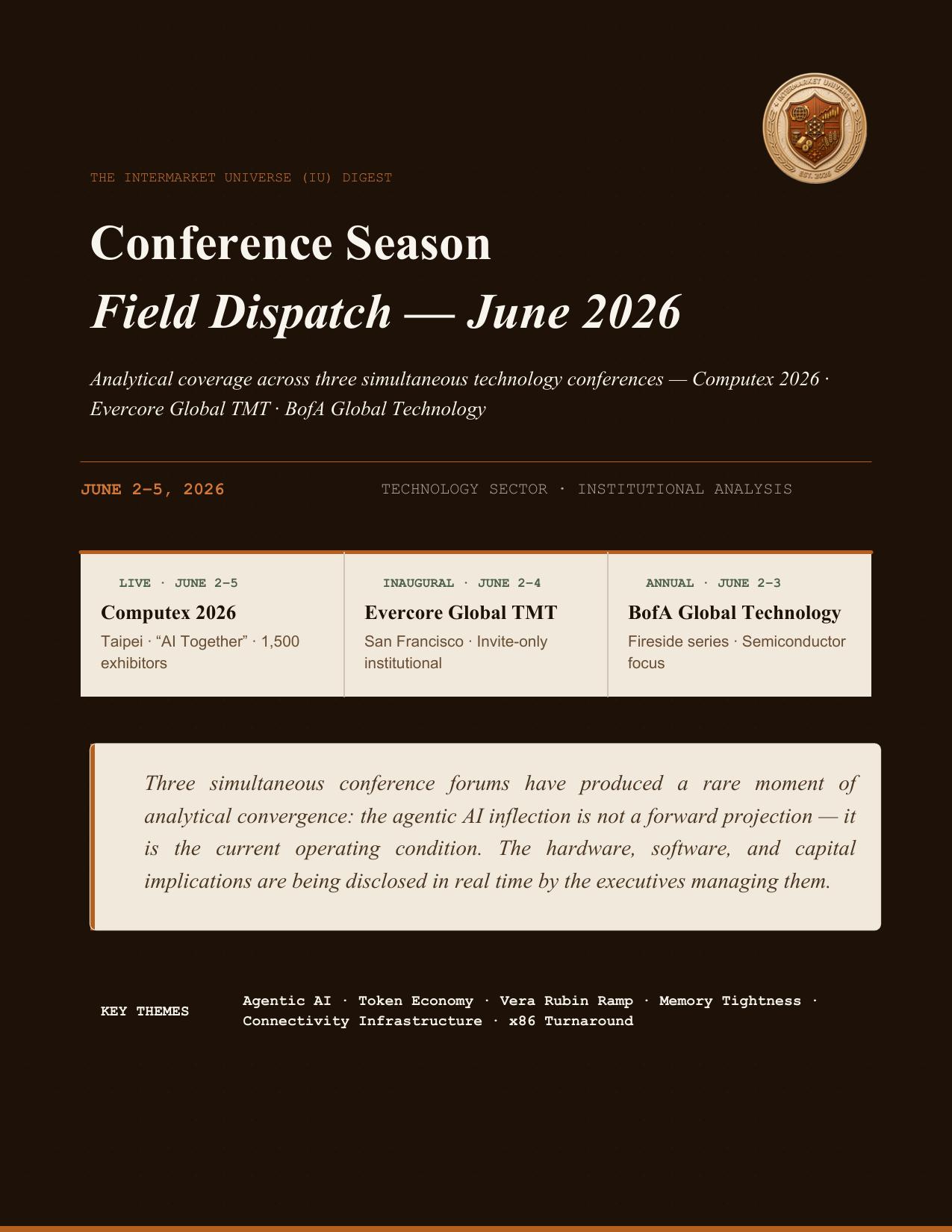
Computex 2026 (Taipei, June 2–5) · Evercore Global TMT (SF, June 2–4) · BofA Global Technology (June 2–3)
12-page field dispatch from Conference Season June 2026 — Computex 2026 (Taipei, June 2–5), Evercore Global TMT (SF, June 2–4), and BofA Global Technology (June 2–3). Covers NVDA Vera Rubin ramp, QCOM Oryon compute, INTC positioning, MRVL connectivity, WDC memory tightness, and five cross-sector themes: Agentic AI, Token Economy, Silicon Sovereignty, Memory Tightness, and Ultra-Bandwidth Connectivity.
This field dispatch synthesizes on-the-ground intelligence and management commentary from three major technology and capital markets conferences that converged during the first week of June 2026. Together they represent the most concentrated signal window of the mid-year semiconductor and AI infrastructure calendar.
Computex remained the flagship venue for silicon product launches, with NVIDIA's Vera Rubin platform generating the most sustained investor attention. Jensen Huang's keynote confirmed a 2H 2026 ramp timeline for Vera Rubin, with Blackwell supply normalization expected by mid-year. QUALCOMM reinforced the Oryon compute roadmap for both PC and edge AI applications, while INTEL used the event to highlight 18A foundry client traction and the expanding ecosystem of external design wins. System-level themes centered on co-packaged optics, 800G+ connectivity for rack-scale AI clusters, and the transition from datacenter-centric inference to edge-distributed architectures.
Evercore's investor-facing format provided the most direct read-through on institutional sentiment. Portfolio managers and sell-side analysts converged on a consistent view: AI infrastructure spend remains durable through 2026 and into 2027, but the composition is shifting from GPU procurement toward the surrounding memory, connectivity, and custom silicon stack. MARVELL's management reinforced the custom silicon thesis, citing expanding engagements with hyperscaler customers for networking ASICs and connectivity fabric. Memory dynamics were a recurring discussion point, with WESTERN DIGITAL providing context on enterprise SSD demand and early indicators of DRAM tightness in DDR5 configurations.
BofA's event attracted C-suite participation across the semiconductor supply chain. INTEL's management articulated the most detailed public commentary on 18A foundry positioning, framing the node as critical to domestic semiconductor sovereignty objectives. The Token Economy theme — the economics of inference at scale, including cost-per-token trajectories and the implications for memory bandwidth — was prominently featured across multiple presenting companies. Agentic AI infrastructure requirements were discussed in the context of continuous inference workloads that place structurally higher demands on HBM bandwidth than batch-based training tasks.
Despite different formats and audiences, the same five structural themes emerged consistently across Computex, Evercore Global TMT, and BofA Global Technology. Each represents a durable investment consideration that extends well beyond the conference cycle.
Five companies generated the most sustained management and investor discussion across the three conferences. The table below summarizes the key signal and investment read-through from each.
| Company | Key Signal | Investor Read-Through |
|---|---|---|
| NVDA NASDAQ | Vera Rubin ramp confirmed for 2H 2026; Blackwell supply normalization expected mid-year | Platform continuity intact; HBM demand remains structurally elevated through the Vera Rubin cycle |
| QCOM NASDAQ | Oryon compute platform reinforced for PC and edge AI; on-device inference expanding workload addressability | Edge AI adoption broadens the inference TAM beyond hyperscale; Oryon differentiates on performance-per-watt |
| INTC NASDAQ | 18A foundry client traction highlighted; domestic manufacturing positioning central to Silicon Sovereignty thesis | Foundry ramp remains the key catalyst; execution risk acknowledged but first external wins broaden the investment case |
| MRVL NASDAQ | Custom silicon and connectivity ASIC engagements expanding; hyperscaler networking fabric demand durable | Custom silicon TAM continues to grow as hyperscalers insource differentiated network and inference silicon |
| WDC NASDAQ | Enterprise SSD demand solid; DRAM tightness in DDR5 configurations emerging as forward supply signal | Memory tightness read-through is positive for pricing power; WDC's diversified NAND/DRAM exposure is a net beneficiary |
Across 72 hours and three distinct venues, the consistent message was that the AI infrastructure investment cycle is broadening and deepening simultaneously. The GPU-centric phase of hyperscaler capex is giving way to a more distributed architecture — one where memory bandwidth, custom silicon, connectivity fabric, and edge inference share the capital allocation equally with compute.
For investors, the signal hierarchy that emerged from Conference Season June 2026 is as follows: NVDA remains the structural anchor of the AI compute stack, but the adjacent opportunity set — HBM supply (SK Hynix, Micron, WDC), custom silicon (MRVL, Broadcom), foundry sovereignty (INTC), and edge compute (QCOM) — is now generating institutional interest that was previously concentrated solely on the GPU layer.
The Token Economy and Agentic AI themes represent a forward demand signal that is just beginning to shape capital allocation decisions. When inference workloads become continuous rather than batch-driven — as agentic architectures require — the memory bandwidth and total system power budgets change materially. This creates a second-order demand pull for HBM, DDR5, and ultra-bandwidth connectivity that is not yet fully priced into the sector.

Subscribe for every future issue — institutional-grade research, independent perspective across semis, memory, AI infrastructure, and macro.
No investment advice. Research only. Unsubscribe anytime.
This research is for informational purposes only and does not constitute investment advice. Intermarket Universe does not hold positions in any securities mentioned unless separately disclosed. All conference commentary and financial data are sourced from publicly available materials, management presentations, and press releases. Past performance is not indicative of future results.