Intermarket Universe Intermarket Universe
Intermarket Universe | Feature Issue
Published April 2026
Intermarket Universe company seal

Broadcom: Building the Operating System of the AI Data Center

A feature issue on how Broadcom sits at the intersection of custom AI silicon, scale-up networking, and VMware-based enterprise infrastructure — making it one of the clearest picks-and-shovels beneficiaries of the AI buildout.
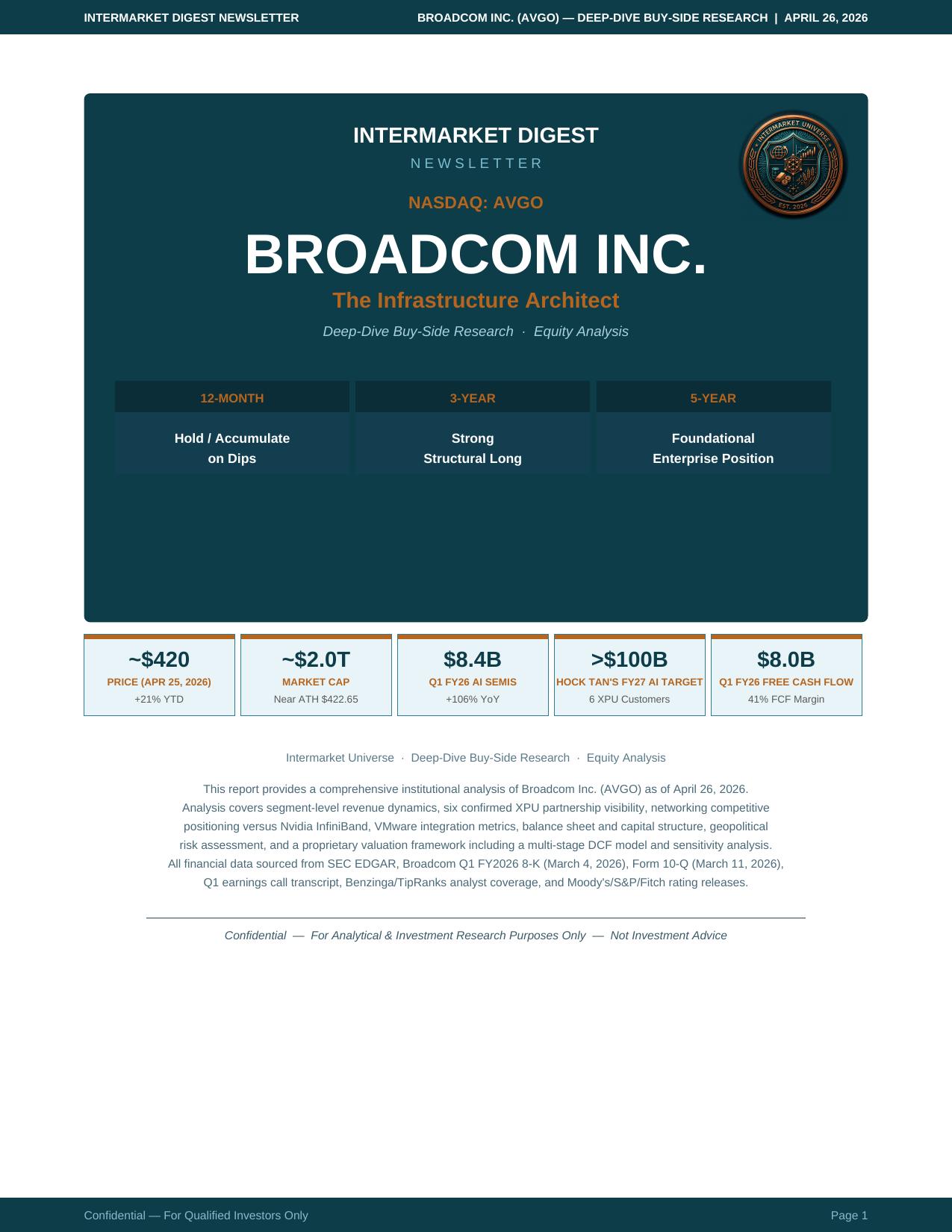
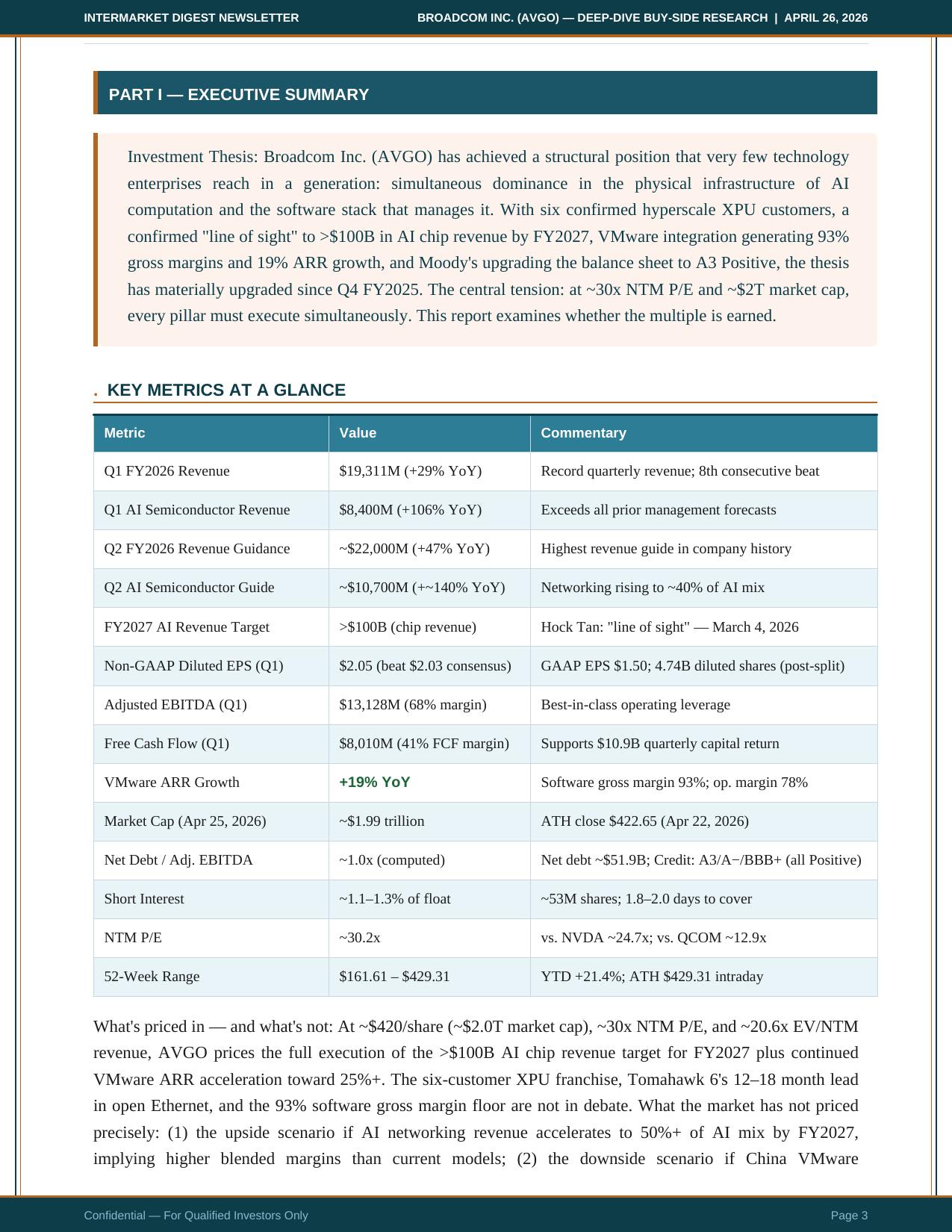
$19.3B
Q1 FY2026 revenue
Broadcom reported record quarterly revenue, reflecting strength in both Semiconductor Solutions and Infrastructure Software.
$8.4B
Q1 AI revenue
AI revenue more than doubled year over year, driven by custom accelerators and AI networking demand.

Broadcom belongs in the center of the AI conversation

Broadcom has become one of the most important but least theatrical companies in the AI buildout. The public narrative still revolves around models, chat interfaces, and GPUs, but the underlying capital cycle is much broader. It includes custom accelerators, networking fabrics, optical links, switching infrastructure, and the enterprise software layers that make large-scale AI practical rather than merely possible.

That is where Broadcom stands out. The company is positioned across several of the most economically valuable layers of the stack at once. In semiconductors, it benefits from hyperscaler demand for custom AI silicon and networking. In software, it owns a large infrastructure platform through VMware that extends Broadcom’s reach into private and hybrid cloud environments. The result is a company that reads less like a single-product winner and more like a systems-level beneficiary of the AI spending cycle.

The Visual Story

Readers increasingly encounter AI through headlines about models, chips, and cloud spending. But the physical buildout is more layered than the headlines suggest. Broadcom’s story is compelling because it spans the compute side of AI, the networking side that allows clusters to scale, and the software layer that helps enterprises operationalize AI inside real infrastructure.

Broadcom infographic artwork preserved intact
Mapping the company

The mind map

Broadcom becomes more interesting the moment the story is widened beyond earnings. The mind map shows how the company’s AI exposure branches into strategy, networking and connectivity, custom accelerators, enterprise infrastructure software, and the financial logic that ties the whole platform together.

That broader view matters. Broadcom is not simply a way to play one AI spending lane. It touches hyperscaler capex, enterprise modernization, cluster interconnect, merchant and custom silicon, and the software environments enterprises use to build private and hybrid AI stacks.

Broadcom AI infrastructure mind map artwork preserved intact

4 Branches Defining the Thesis

Strategy

Broadcom’s AI exposure is strongest when viewed as a systems-level strategy rather than a chip-by-chip revenue story. The company sits where AI demand becomes architecture.

Networking & connectivity

As AI clusters get larger, interconnect becomes mission-critical. Broadcom benefits not only from compute demand but also from the movement of data across the system.

Custom accelerators

Customer-specific silicon gives Broadcom a differentiated role in the market, embedding the company directly into hyperscaler roadmaps rather than generic merchant demand.

Infrastructure software

VMware broadens the story into enterprise infrastructure, giving Broadcom a software bridge to private cloud and hybrid cloud AI adoption.

The semiconductor engine

Fiscal Q1 2026 made Broadcom’s AI positioning harder to ignore. The company reported record quarterly revenue of $19.311 billion, including $12.515 billion from Semiconductor Solutions and $6.796 billion from Infrastructure Software. The headline figure inside that quarter was AI revenue: $8.4 billion, up 106% year over year.

That surge matters because Broadcom is not trying to win a generic chip contest. Its strategy is to embed itself in customer roadmaps through purpose-built accelerators and the surrounding connectivity required to make massive AI clusters function.

The less glamorous moat

Networking is where scale becomes real

Compute may dominate headlines, but data has to move across increasingly complex systems at very high speed and under tight power and latency constraints. Broadcom’s networking position gives it exposure to that scaling problem, which becomes more valuable as model sizes and cluster sizes rise.

This is what gives Broadcom a more durable AI narrative than a narrow accelerator thesis. The company benefits not only from the creation of compute, but also from the movement and orchestration of data inside the AI data center.

VMware changed the shape of the company

The VMware acquisition added a strategically distinct layer to Broadcom’s identity. It gave the company a large infrastructure software base that is increasingly relevant to the same enterprise customers trying to modernize data centers for AI workloads.

That matters for two reasons. First, software adds recurring revenue that can smooth the earnings profile relative to a pure hardware story. Second, it gives Broadcom a role in the enterprise side of AI adoption, where many customers prefer private cloud and hybrid cloud architectures rather than relying entirely on public hyperscalers.

The investment tension

Powerful positioning, real concentration risk

Broadcom’s appeal is obvious, but so is the tension. AI revenue is growing at an extraordinary pace, yet that growth remains tied to a relatively small number of major customers and to very heavy infrastructure spending cycles.

If hyperscaler capex slows, project timing shifts, or custom silicon programs change direction, the market’s enthusiasm could cool quickly. That tension gives the name its charge: a stronger company, a better business mix, and a valuation still tethered to the durability of AI momentum.

Bull case

  • AI revenue growth remains exceptional and supported by both custom silicon and networking.
  • Broadcom’s role inside customer-specific architectures creates stickier positioning than a purely merchant model.
  • Infrastructure software provides a large recurring layer that supports margins and diversification.

Bear case

  • Customer concentration remains meaningful, especially if a handful of hyperscaler programs drive the growth narrative.
  • AI infrastructure spending could normalize or shift in timing, creating near-term volatility.
  • Valuation sensitivity to AI momentum means strong execution still may not fully protect the stock from sentiment reversals.